




 USD
USD
Flow Blockchain Exploit Triggers Governance Reckoning as $3.9M Breach Sparks Price Collapse and Recovery Overhaul


Network Halt, Rollback Backlash, and a Phased Recovery Redefine Flow’s Crisis Response
TL;DR
- Flow suffered a $3.9 million exploit on Dec. 27, 2025, forcing a network halt and triggering a sharp crypto price collapse of more than 40%.
- An initial rollback proposal was scrapped after heavy criticism, replaced by a phased “isolated recovery” plan targeting exploit-linked accounts.
- Market confidence took a major hit as governance decisions, exchange activity, and systemic risk became central to the fallout.
We’ve just launched the all-new COIN360 Perp DEX, built for traders who move fast!
Trade 130+ assets with up to 100× leverage, enjoy instant order placement and low-slippage swaps, and earn USDC passive yield while climbing the leaderboard. Your trades deserve more than speed — they deserve mastery.
Flow’s blockchain crisis escalated quickly after a $3.9 million exploit was detected on Dec. 27, 2025, prompting validators to halt block production and freeze network activity. The breach stemmed from a vulnerability in Flow’s execution layer that allowed an attacker to mint assets without authorization and move funds across bridges before emergency measures were enacted. Once abnormal transactions were identified, the network was stopped at a fixed block height to prevent further losses, immediately disrupting decentralized applications, NFT platforms, and cross-chain operations built on Flow.
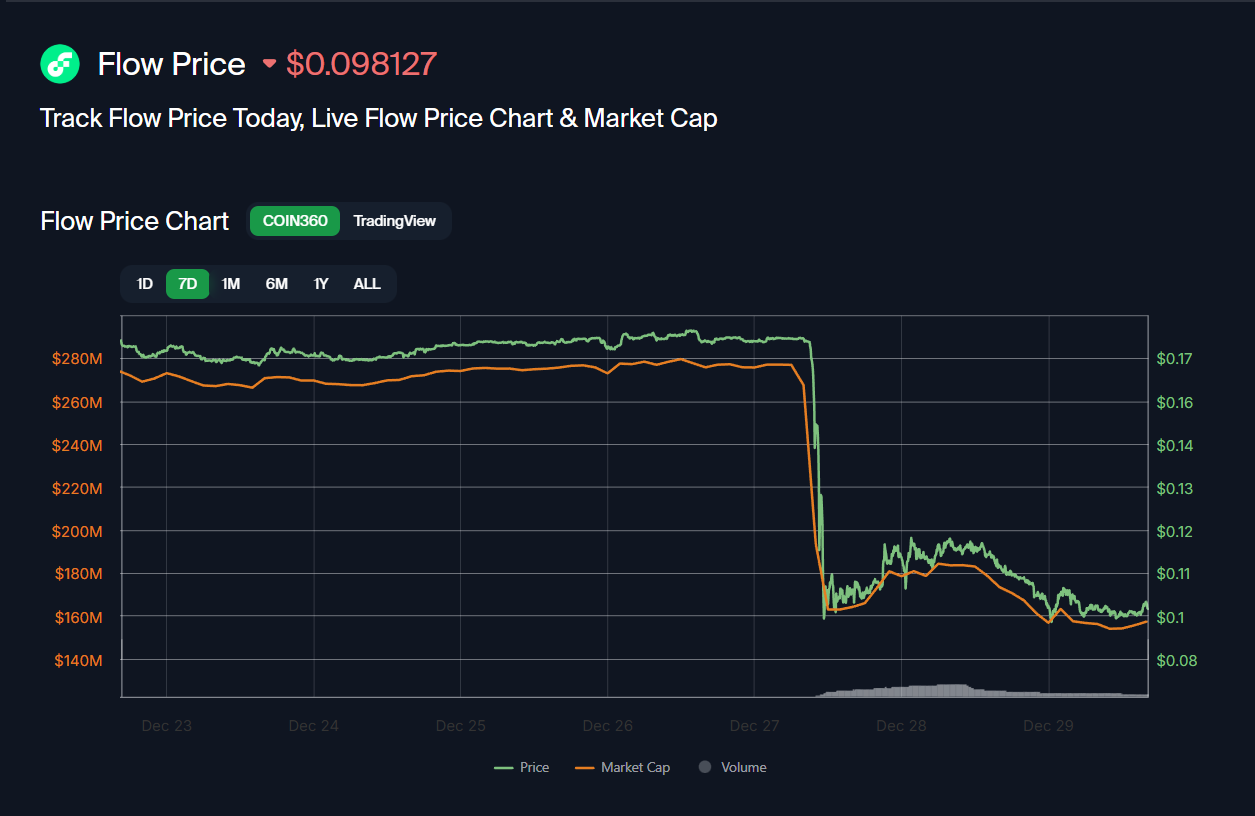
Market reaction was swift and unforgiving. FLOW’s crypto price plunged more than 40% within hours, briefly touching lows near $0.08 as liquidity dried up and uncertainty spread. Several centralized exchanges suspended deposits and withdrawals, amplifying volatility and pushing derivatives funding rates sharply negative as traders positioned for further downside. The scale of the price drop far exceeded the dollar value of the exploit itself, signaling a deeper confidence shock tied to governance risk rather than pure financial loss. Relative to the broader crypto price index, FLOW underperformed sharply, reflecting concerns unique to the network rather than macro market pressure. The coin market cap erosion underscored how quickly trust can evaporate when core protocol integrity is questioned.
Initial attempts to contain the damage sparked a second wave of controversy. Flow developers and the Flow Foundation floated a rollback plan that would rewind the blockchain to a pre-exploit state, effectively erasing the attacker’s transactions. The proposal aimed to preserve user balances but immediately ignited backlash from validators, bridge operators, and infrastructure providers. Critics warned that reversing finalized transactions would undermine immutability, create accounting inconsistencies across bridges and exchanges, and potentially cause more harm than the exploit itself. Technical voices stressed that the attacker had already bridged funds off-chain, making a rollback ineffective while punishing unaffected users. The debate quickly evolved into a referendum on decentralization versus emergency intervention.
Community pressure forced a pivot. Flow formally abandoned the rollback approach and introduced a phased “isolated recovery” plan designed to preserve legitimate transactions while targeting exploit-linked accounts. Under this framework, addresses associated with the breach were restricted, certain environments were temporarily set to read-only, and validators coordinated on a software upgrade to safely resume operations. Phase one focused on stabilizing the network and restoring basic functionality, while phase two addressed deeper remediation, including re-enabling Ethereum Virtual Machine compatibility and cleaning up residual exploit effects. Governance actions were carried out under validator authorization, with the foundation emphasizing that all remediation steps would remain publicly auditable on-chain.
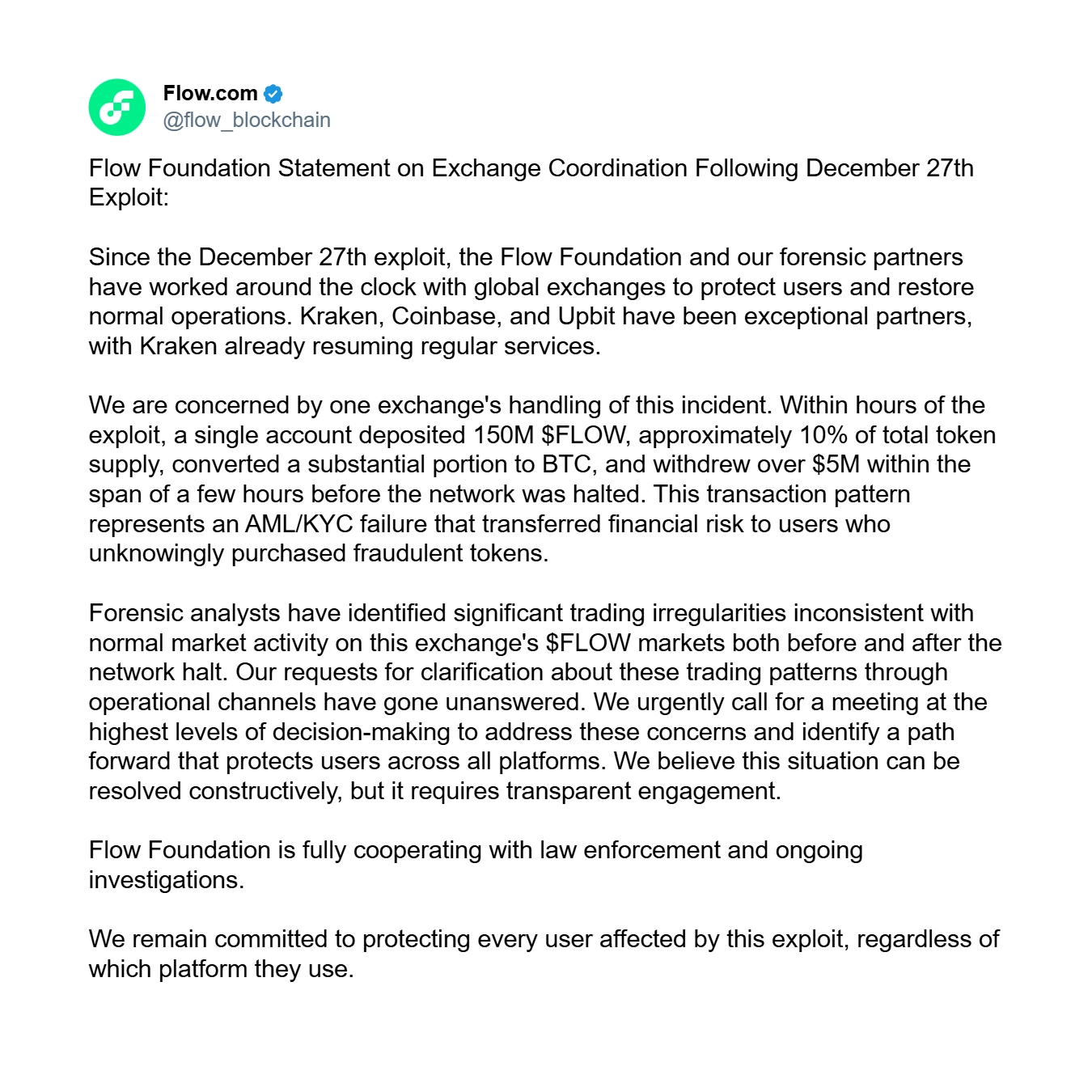
Additional scrutiny fell on exchange activity surrounding the incident. Flow disclosed that a single account deposited roughly 150 million FLOW—about 10% of total token supply—onto a centralized exchange shortly after the exploit, with part of the position converted into bitcoin and withdrawn before the network halt. The foundation characterized the episode as a potential AML and KYC failure, noting that such movements shifted risk onto unsuspecting market participants during a period of extreme instability. The revelation added another layer to the crisis, linking protocol security, exchange oversight, and systemic risk in a single narrative.
The fallout extended beyond spot markets. NFT lending platforms reported loans maturing during the network pause, with some settlements delayed or defaulted due to restricted transfers. DeFi applications and bridges paused activity to avoid compounding exposure, illustrating how a Layer-1 failure can cascade through dependent ecosystems. As Flow progresses through its recovery phases, the episode stands as a case study in how technical exploits, governance decisions, and market psychology intersect—often with consequences that far outlast the original breach.
This article has been refined and enhanced by ChatGPT.


