




 USD
USD
Lighter’s LIT Token Launch Exposes the Friction Between Mega Airdrops, Institutional Liquidity, and Market Trust


A record-scale airdrop, sharp capital movements, and a $24 million market-maker deal collide in Lighter’s first days on the market
TL;DR
- Lighter launched LIT with a 25% supply airdrop worth roughly $650–675 million, placing it among the largest token distributions in crypto history.
- Around $250 million exited the protocol within 24 hours, while price swings, whale selling, and short positioning intensified scrutiny.
- Disclosure that Jump Crypto received over $24 million in LIT for market-making clarified early liquidity support but raised fresh transparency questions.
We’ve just launched the all-new COIN360 Perp DEX, built for traders who move fast!
Trade 130+ assets with up to 100× leverage, enjoy instant order placement and low-slippage swaps, and earn USDC passive yield while climbing the leaderboard. Your trades deserve more than speed — they deserve mastery.
Lighter’s entry into the market with its native LIT token unfolded as a high-stakes experiment in modern token design, compressing a massive airdrop, institutional liquidity provisioning, and full price discovery into a matter of hours. The protocol distributed roughly 25% of total LIT supply at the Token Generation Event, an unusually aggressive approach that immediately placed a significant share of circulating tokens into the hands of users, liquidity providers, and early participants. At launch prices, the airdrop was valued at approximately $650–675 million, ranking LIT among the ten largest airdrops ever executed.
That scale ensured instant liquidity and visibility, but it also left little margin for error. Price discovery was immediate and unforgiving. LIT debuted near $3.30, slid roughly 32% to around $2.20, then rebounded toward $2.60 within hours. The swings reflected a market absorbing months’ worth of distribution in real time, as airdrop recipients weighed profits against long-term exposure and traders positioned for volatility. Derivatives data showed a modest skew toward short positions, with about 54% of top accounts positioned short versus 45% long, suggesting widespread hedging rather than outright bearish conviction.
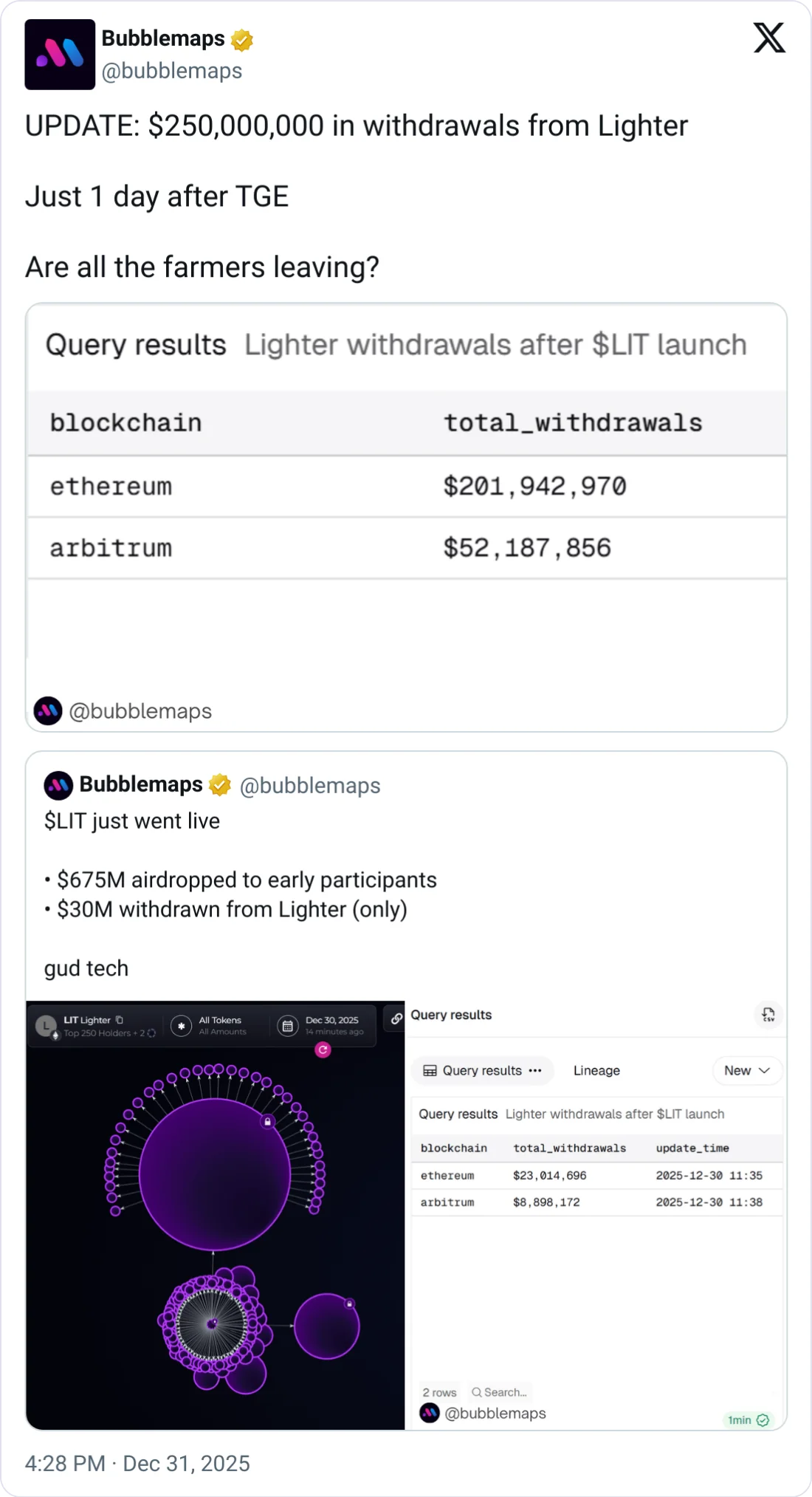
Capital flows added another layer of complexity. On-chain data showed that approximately $250 million was withdrawn from the Lighter protocol within 24 hours, equivalent to about 20% of its roughly $1.4 billion total value locked. While the headline number fueled talk of capital flight, net outflows after accounting for deposits were closer to $101 million, a figure several analysts described as proportionate given the size of the airdrop. Much of the movement appeared tied to liquidity providers rebalancing positions rather than retail users exiting en masse, a distinction that challenged early narratives of panic selling.
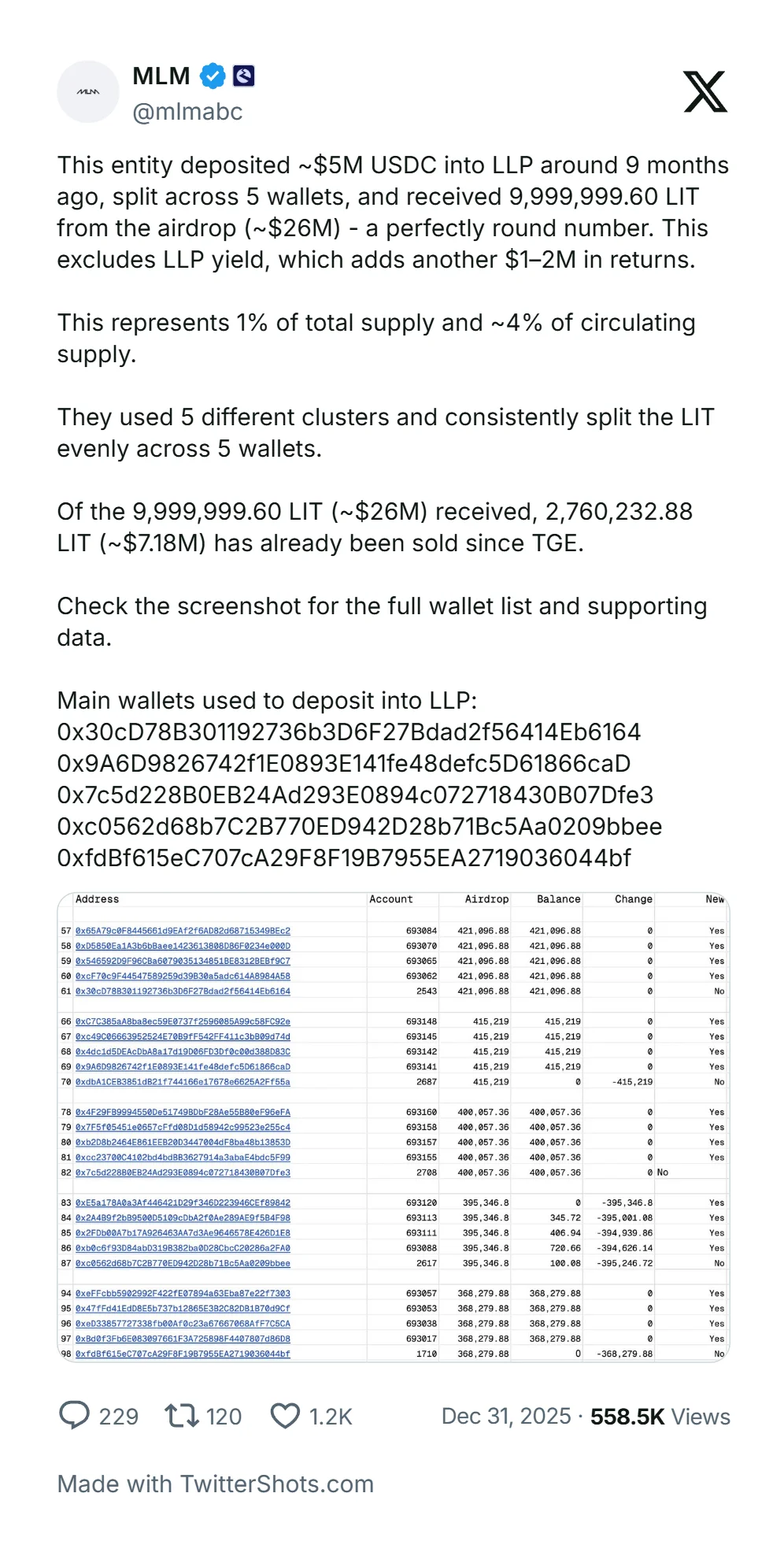
Wallet-level data reinforced that interpretation, while introducing new concerns of its own. Analysis identified five linked wallets that collectively received just under 10 million LIT, valued at roughly $26 million and representing about 4% of circulating supply. These wallets were not newcomers. Records showed they had deposited around $5 million in USDC into Lighter’s Liquidity Provider Program as early as April 2025, positioning themselves well ahead of the airdrop. In addition to the token distribution, the wallets earned an estimated $1–2 million in yield, amplifying their effective exposure.
Post-launch, the same cluster sold approximately 2.76 million LIT, worth about $7.18 million, into the open market. The pace and coordination of the sales drew scrutiny from analysts, who characterized the activity as strategic rather than incidental. Observers pointed to a broader issue: the absence of clear disclosure around allocation categories, vesting schedules, and lockups. Without that context, distinguishing between routine liquidity management and preferential selling became difficult, even in the absence of direct evidence of insider wrongdoing.
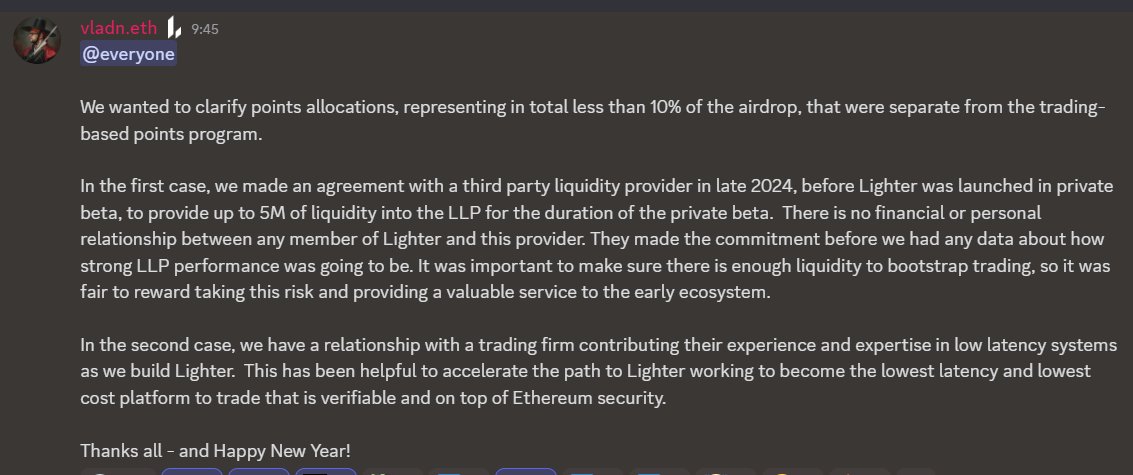
Market sentiment deteriorated further as rumors circulated. LIT fell roughly 8.5% over a 24-hour period, briefly trading near $2.43. Lighter CEO Vladimir Novakovski responded publicly, stating that the wallets under scrutiny belonged to a third-party liquidity provider involved during the private beta, not members of the core team. He emphasized that no undisclosed personal or financial relationships existed between the team and the entity, aiming to separate liquidity bootstrapping from allegations of internal dumping.
A separate disclosure added clarity while intensifying debate. Reports suggested that Jump Crypto received more than $24 million worth of LIT tokens as compensation for market-making services, making it one of the largest non-airdrop recipients of protocol-issued tokens.
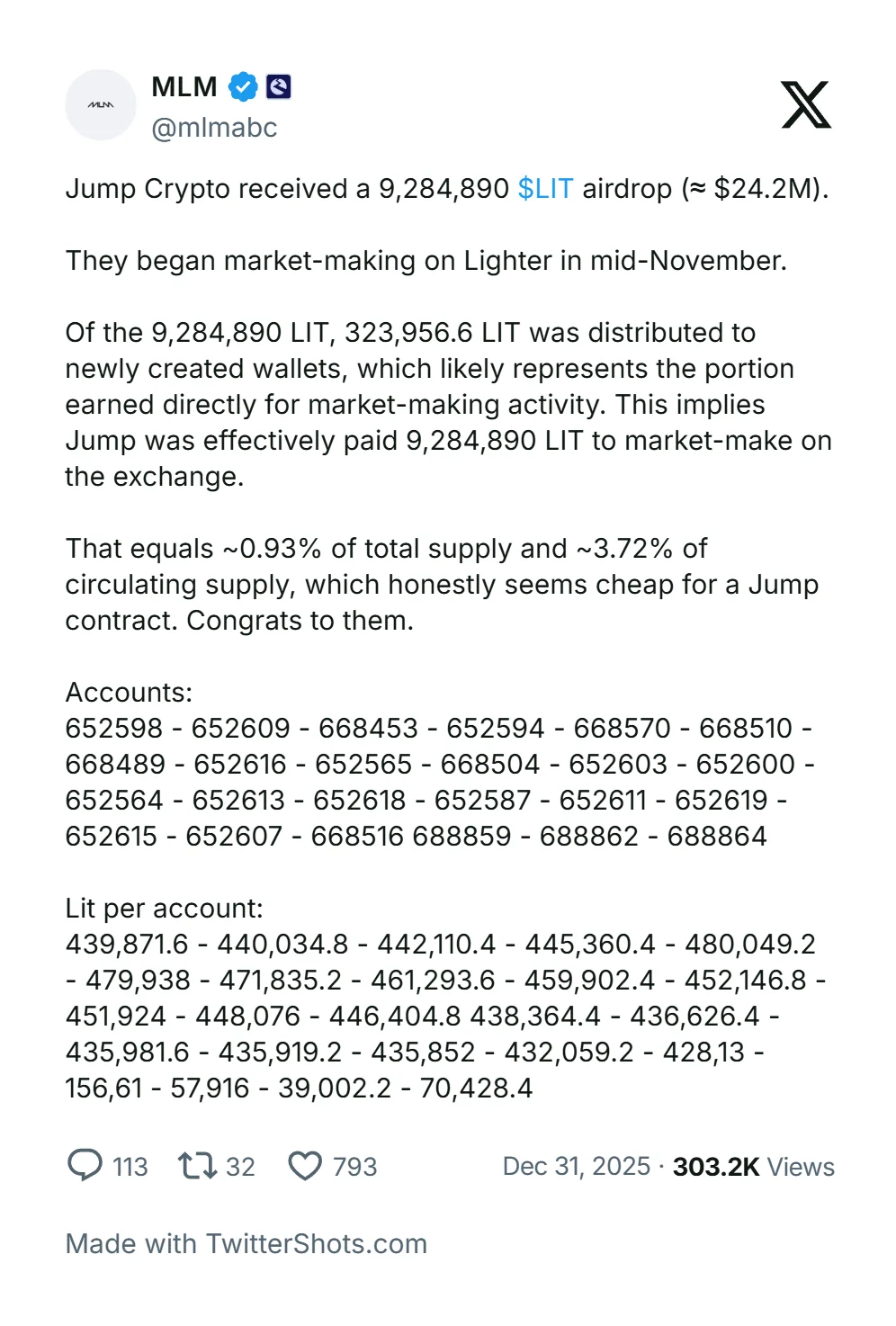
Jump Crypto also retained approximately 323,956 LIT as fees, indicating active, ongoing liquidity provision rather than a one-time grant. Such arrangements are standard in both traditional and crypto markets, particularly for new trading venues seeking tight spreads and functional order books. Yet the size of the allocation, combined with limited upfront communication, turned the deal into a focal point during an already volatile launch.
This article has been refined and enhanced by ChatGPT.


