




 USD
USD
U.S. Senate Bans Prediction Market Trading as Sector Expands


Lawmaker Restrictions Come Before ETF Filings, Gemini Approval and Polymarket Oversight Push
TL;DR
- The U.S. Senate unanimously banned senators from trading on prediction markets, effective immediately.
- The restriction came as prediction market volume reached $25.7 billion in March.
- ETF issuers, Gemini and Polymarket are still pushing deeper into regulated event-market infrastructure.
We’ve launched the all-new COIN360 Perp DEX, built for traders who move fast!
Trade 130+ assets with up to 100× leverage, enjoy instant order placement and low-slippage swaps, and earn USDC passive yield while climbing the leaderboard. Your trades deserve more than speed — they deserve mastery.
The U.S. Senate unanimously passed a rule on April 30, 2026, barring senators from trading on prediction markets, effective immediately, as the sector faces rising scrutiny over insider trading while expanding through ETF filings, crypto infrastructure, regulated derivatives licenses and onchain surveillance tools.
The restriction came amid concern about insider trading on platforms such as Kalshi and Polymarket, as well as event contracts involving death or violence. Kalshi announced on April 22 that it had suspended and fined one U.S. Senate candidate and two House of Representatives candidates for political insider trading on their own campaigns.
On April 23, U.S. Army Special Forces soldier Master Sgt. Gannon Ken Van Dyke was arrested on an indictment accusing him of using classified information to make bets on Polymarket tied to the U.S. military mission that captured Venezuelan leader Nicolás Maduro. The Department of Justice said Van Dyke was involved in that mission and won nearly $410,000 on those wagers.
A group of Democratic members of Congress called on the CFTC to issue a rule “that prevents insider trading and corruption in the market and prohibits event contracts on the outcome of elections, war and military actions in the U.S. or abroad, sports, and government actions without a valid economic hedging interest.” The Banning Event Trading on Sensitive Operations and Federal Functions Act would seek to end wagers on government actions and events where an individual has control or may know the outcome in advance.
Prediction Market ETFs Near Potential Launch
Bloomberg ETF Analyst James Seyffart said on April 29, 2026, that the first lineup of prediction market exchange-traded funds could launch in the U.S. “next week” after Roundhill filed a post-effective amendment under Rule 485(b) with the SEC. Seyffart said, “Looks like we are going to see prediction markets ETFs launch next week,” after the filing set a May 5 effective date for six election-linked funds.
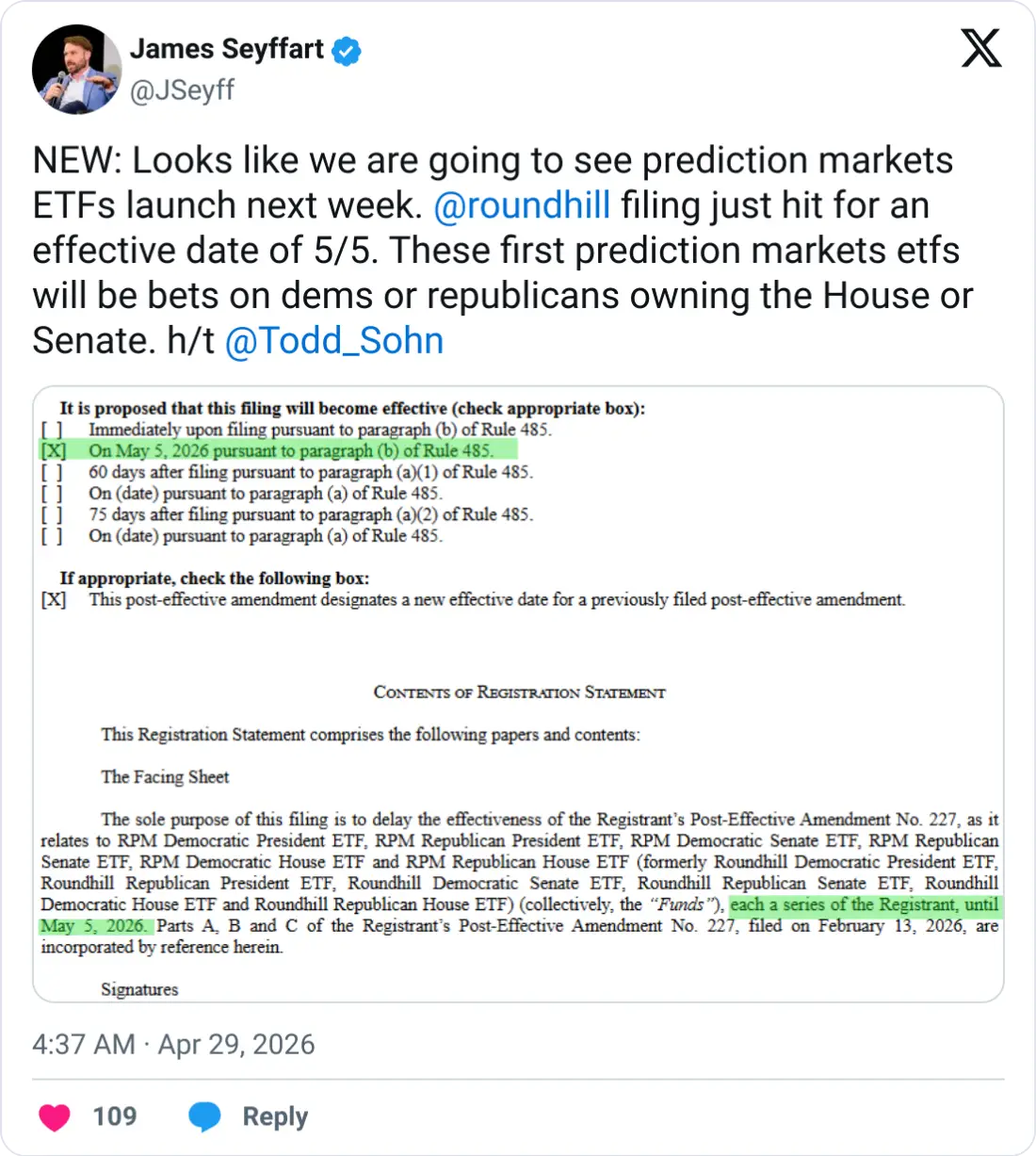
Roundhill’s planned funds are the RPM Democratic President ETF, RPM Republican President ETF, RPM Democratic Senate ETF, RPM Republican Senate ETF, RPM Democratic House ETF and RPM Republican House ETF. Roundhill’s February filing said the funds would allow investors to speculate on U.S. election outcomes through event contracts, with each fund designed to deliver capital appreciation if the targeted party wins and a near-total loss if it loses.
The President ETFs are tied to the winner of the 2028 presidential election, while the Senate and House ETFs are tied to the November 2026 midterm elections. GraniteShares and Bitwise also submitted similar filings in February, and Seyffart expected those products to launch around the same time as Roundhill’s funds. Seyffart previously described the move as part of a broader “financialization and ETF-ization of everything,” adding that it was unlikely to be the last filing of its kind. Bloomberg Senior ETF Analyst Eric Balchunas called Roundhill’s filing “Potentially groundbreaking,” adding, “If this goes through, wow, opens up huge door to all kinds of stuff.”
Retail Users Drive Prediction Market Growth
Prediction market activity has already expanded sharply before the potential ETF launches. Polymarket and Kalshi recorded a combined $24.3 billion in volume in March, while another cited market measure said the two platforms reached a record $23.6 billion in trading volume that month, according to Token Terminal data.
A Bitget Wallet report produced in collaboration with Polymarket said prediction market volume climbed to $25.7 billion in March, up 10.6% from February. The report tracked 1.29 million wallets during the first quarter of 2026 and found that retail users dominated activity, with 82.3% of users trading less than $10,000.
Crypto served as the main entry point for small users, accounting for 39.6% of activity among micro users. The report attributed crypto’s onboarding role to continuous market access, familiar price dynamics and low entry thresholds. Median trade sizes were typically around $2 to $3, showing that much of the market’s growth came from small users rather than only high-value traders.
The report said crypto helps users enter prediction markets, but sustained engagement increasingly shifts toward recurring real-world events. It said user engagement deepens through category expansion rather than larger trade sizes. Micro users averaged 2.5 active days and 1.45 categories, while mid-tier users averaged 9.9 active days and 2.34 categories. Smaller categories, including pop culture, finance, weather, and science and technology, recorded lower volumes but still contributed to broader category expansion.
Gemini and Polymarket Build Market Infrastructure
Gemini Space Station received CFTC approval on April 30, 2026, for a derivatives clearing organization license, giving the crypto exchange run by Cameron and Tyler Winklevoss a stronger regulated pathway into derivatives and prediction markets. The DCO approval allows Gemini to clear and settle trades in-house instead of relying on outside providers, giving the company more control over how its prediction market products function and scale.
Gemini shares climbed about 7% after the DCO approval announcement. Prediction market trading volume increased more than 300% in 2025 to $63.5 billion. Gemini’s DCO approval builds on the company’s December 2025 debut of a prediction marketplace through Gemini Titan, another affiliate that received CFTC designated contract market authorization.
With both DCM and DCO licenses in place, Gemini said it is positioned to offer a full-stack trading ecosystem spanning sports, crypto, futures, options and event-based contracts. Gemini also said it intends to expand into crypto futures, options and perpetuals for U.S. users. Hyperliquid, a DeFi derivatives platform, is preparing to compete with incumbents such as Kalshi and Polymarket.
Polymarket also moved to strengthen market oversight, tapping Chainalysis on April 30, 2026, to monitor trading activity and enforce market rules. Chainalysis is bringing investigative software and onchain monitoring systems designed to flag suspicious behavior based on patterns consistent with traders acting on non-public information.
The partnership came as prediction markets faced growing scrutiny over whether political operatives, corporate employees or other insiders could place informed bets before information becomes public. Polymarket’s answer is to lean into blockchain transparency because every trade is recorded onchain, allowing activity to be traced and analyzed after the fact.
Polymarket CEO Shayne Coplan said, “Polymarket was built onchain because transparency matters, and our platform shows what markets can look like when trades are open, traceable, and accountable by design.” Coplan has also described prediction markets as “a very useful thermometer of the world.”
Trump Softens Earlier Criticism
President Donald Trump softened his stance on prediction markets on April 28, 2026, after previously saying he was not happy with them. Asked about his earlier comments, Trump told reporters in Florida, “I don’t know. I know some people who are very smart. They like it.” He added, “They disagree, but they like it.”
Trump also said, “A lot of other countries are doing it, and when the other countries do it, we get left out in the cold if we don’t do it.” His softer comments followed earlier remarks at the White House, where he responded to a question about well-timed bets tied to events linked to the Iran war by saying, “Well, you know, the whole world, unfortunately, has become somewhat of a casino.”
Trump added in those earlier remarks, “And you look at what’s going on all over the world and Europe, and every place they’re doing these betting things. I was never much in favor of it. I don’t like it conceptually, but it is what it is.” He also said, “I think that I’m not happy with any of that stuff, but they have all these different sites of predictive markets. It’s a crazy world. It’s a much different world than it was.”
Donald Trump Jr. invested in Polymarket in August and joined the company’s advisory board. He is also an adviser to Kalshi, having taken the role in January 2025. Trump Media said in October that it would roll out prediction markets in partnership with Crypto.com on Truth Social. Trump divested his stake in Trump Media upon entering office, transferring his shares to a trust for which Trump Jr. is the sole trustee.
FAQ
What did the U.S. Senate do?
The Senate unanimously banned senators from trading on prediction markets, effective immediately.
Why are prediction markets under scrutiny?
Concerns include insider trading, politically sensitive contracts and event markets involving death or violence.
When could the first prediction market ETFs launch?
They could launch May 5, according to Bloomberg ETF Analyst James Seyffart.
What was March prediction market volume?
Bitget Wallet and Polymarket said monthly volume reached $25.7 billion.
This article has been refined and enhanced by ChatGPT.


