




 USD
USD
Coin360 Weekly Dispatch | Crypto Market Updates & Highlights | April 5-11, 2026


Trade Like You Mean It: The COIN360 Perp DEX Is Live
We’ve launched the all-new COIN360 Perp DEX, built for traders who move fast!
Trade 130+ assets with up to 100× leverage, enjoy instant order placement and low-slippage swaps, and earn USDC passive yield while climbing the leaderboard. Your trades deserve more than speed — they deserve mastery.
Weekly Crypto Market Performance
Period: April 5-11, 2026
Total crypto market cap: $2.44T
Crypto Fear & Greed Index: 15 (Extreme Fear)
BTC.D: 59.68%
Price action
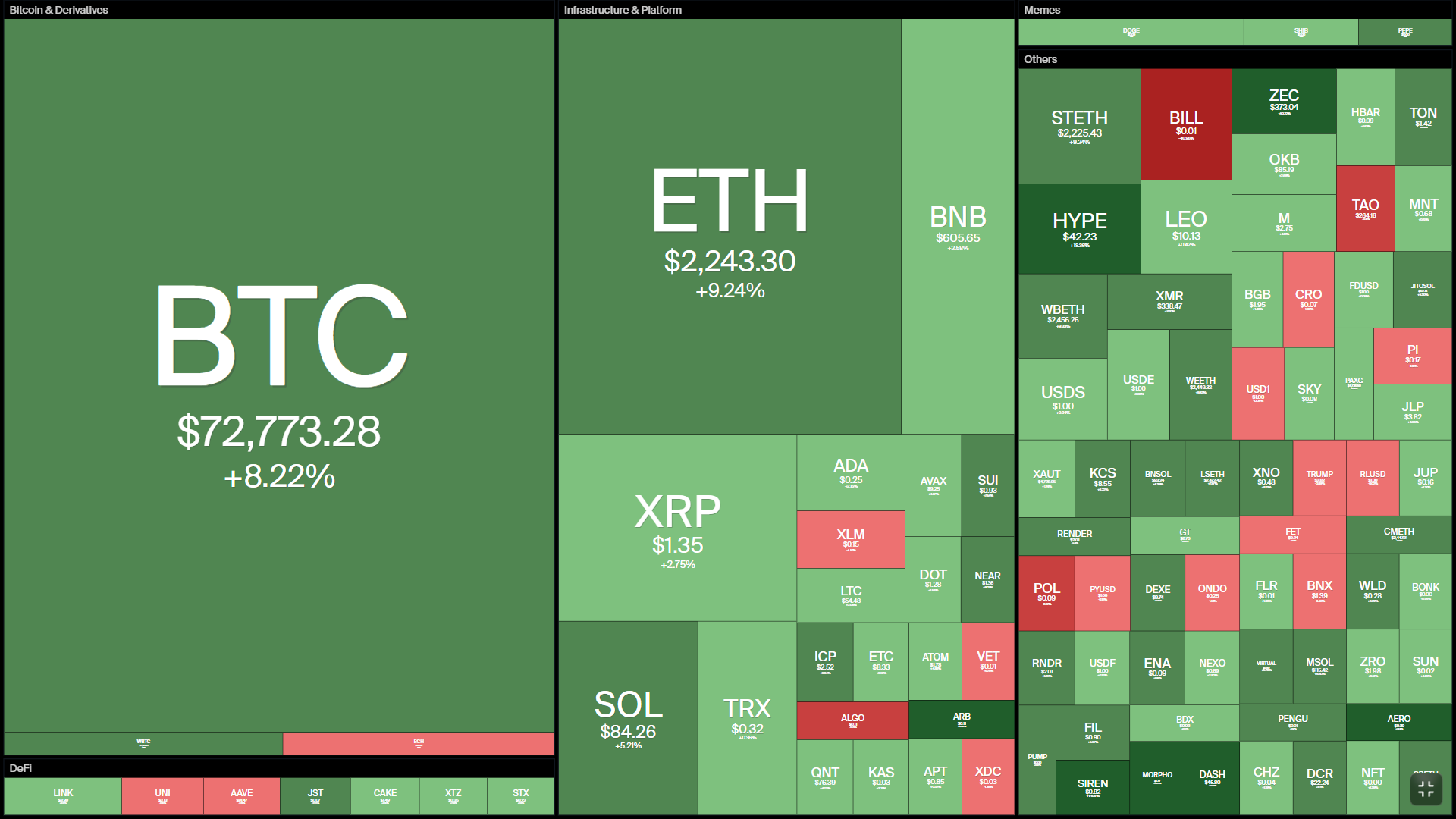
Bitcoin and Ethereum both finished the week higher, with ETH slightly outperforming BTC, as the market clawed back from early-week geopolitical stress and then held most of the ceasefire-driven rebound. BTC gained about 8.22% for the week and ETH about 9.24%, with BTC swinging from a roughly $66,624 intraday low on April 5 to a weekly high near $73,401 on April 10, while ETH ranged from about $2,022 to roughly $2,270.
Market structure and crypto-native fundamentals
U.S. spot Bitcoin ETFs absorbed about $816.9 million net during the April 6 to April 10 trading week, with the launch of Morgan Stanley’s MSBT as one of the supportive catalysts, and spot Ethereum ETFs added about $187.1 million, which reinforced the rebound after a shaky start to the week.
However, sentiment is not increased significantly for altcoins. According to long-time crypto investor Santiago Roel Santos, founder and CEO of crypto private equity firm Inversion, crypto tokens are experiencing significant discounts in secondary markets, with many averaging around 90%, though this figure is token and structure-specific rather than a universal trend.
Median discounts range from 40% to 50% for shorter vesting periods and increase to 70% or higher for longer durations. Factors contributing to these discounts include weak market sentiment, liquidity issues, and token value accrual problems. Investors are shifting focus from locked tokens to equities, leading to tighter discounts in high-quality assets. Current structures may need re-evaluation to attract more investors and enhance liquidity in the market.
Macro context
The macro narrative this week was dominated by two overlapping events: a fragile geopolitical ceasefire and a high-stakes inflation print. On the geopolitical side, the war had dampened investors' appetite for risk, affecting crypto and stock prices, and while the temporary ceasefire doesn't guarantee an end to the conflict, it signals a pause in escalation, which served as a tailwind for Bitcoin, Ethereum, and other high-risk assets. But the ceasefire's credibility was challenged: gold edged higher to $4,750 on Thursday as investors weighed the fragility of the U.S.-Iran ceasefire amid a complex Middle East war, with the Strait of Hormuz conflict, a senior Iranian official stating three provisions of the ceasefire proposal had already been breached, and Israel's attack on Lebanon, prompting Tehran to threaten retaliation.
In his latest Truth Social post, US President Donald Trump announced the initiation of clearing the Strait of Hormuz to enhance security for vital maritime oil routes. He emphasized the move's global significance, citing countries like China, Japan, South Korea, France, and Germany as beneficiaries.

On the inflation side, the BLS released March CPI data on April 10, representing the first look at how the spike in oil prices — driven by the Iran conflict — impacted consumer inflation. Headline inflation accelerated to 3.3% year over year and 0.9% month over month because of the prior energy shock, even as core CPI at 0.2% month over month was softer than feared.
Bitget Research's Ryan Lee characterized digital assets as trading in a "mature macro framework," where short-term capital rotation is primarily shaped by inflation signals, energy prices, and geopolitical stability, and stated that despite moderated near-term rate cut expectations following the CPI report, the Federal Reserve's balance sheet policy is still loose enough to keep overall liquidity from collapsing. Expectations for rate cuts have broadly faded, replaced by projections that rates will stay elevated well into Q2 2026, macro conditions that typically tighten liquidity and limit price appreciation.
Cross-asset comparison
BTC and ETH traded more like high-beta macro assets than decoupled stores of value. U.S. equities logged their strongest week since November, with the Nasdaq up 6.33%, the S&P 500 up 4.67%, and the Dow up 3.11%, while crude posted a brutal weekly drop of -16.42%, Brent oil fell 15.18%, and gold still managed a roughly 2.4% gain. Against that tape, crypto’s rebound sat above equities and havens: in a reverse trend with oil, stronger than the risk-on bounce in stocks, but still sensitive to the same ceasefire and inflation headlines driving everything else.
Regulation & Policy
Treasury Secretary Bessent Presses Senate on CLARITY Act as Global Crypto Rules Tighten
Treasury Secretary Scott Bessent urged Senate Banking Republicans on April 9 to advance the Digital Asset Market Clarity Act, which passed the House in July 2025 but has stalled in the Senate for over 260 days. The central unresolved fight is whether stablecoin issuers can pay yield — a White House analysis found the banking impact would be minimal, but opposition from banking groups and Senate Democrats persists. Polymarket traders priced 63–72% odds of passage in 2026; TD Cowen put it closer to one in three. Internationally, Hong Kong issued its first stablecoin licenses, Japan reclassified crypto as financial instruments, and South Korea, France, Thailand, and Poland each tightened exchange controls or tax disclosure rules.
Charles Schwab Opens Bitcoin, Ether Trading Waitlist
Charles Schwab opened a waitlist for "Schwab Crypto," a new direct-trading account for bitcoin and ether targeting a limited Q2 2026 rollout. The product requires an existing Schwab brokerage account and will not allow transfers from external wallets at launch. Schwab reports $12.22 trillion in client assets and 38.9 million active brokerage accounts. The move follows a multi-year reversal from the firm's 2019 dismissal of crypto as "purely speculative." Morgan Stanley is simultaneously preparing spot crypto through E*Trade via Zerohash, and EDX Markets — backed by Schwab, Citadel, and Fidelity — applied for an OCC national bank charter in the same week.
Prediction Markets Surge as Polymarket Upgrades and Kalshi Wins Appeal
Prediction market volume reached $25.7 billion in March 2026, following a January record of $26.75 billion. On April 6, Polymarket launched its biggest infrastructure overhaul yet — introducing Polymarket USD, a wrapped stablecoin backed 1:1 by USDC replacing bridged USDC.e, alongside the rebuilt CTF Exchange V2. Polymarket held 96.8% of onchain prediction market fee share in Q2's first week, with TVL above $432 million. Kalshi won a federal appeals ruling the same day, with the Third Circuit finding New Jersey lacks authority to block its sports event contracts under state gambling law. One dissenting judge called Kalshi's approach "a performative sleight."
Quantum Threat
Bitcoin Quantum Threat Draws Renewed Warnings from Researchers and Industry Figures
Research published between April 6–8 converged on the view that quantum computing poses a real but medium-to-long-term risk to Bitcoin, focused on wallet cryptography rather than mining. A GSR survey of 26 experts put the odds of a cryptographically relevant machine at 28–49% within 10 years. Bernstein said exposure concentrates in roughly 1.7 million BTC in legacy wallets. Grayscale flagged 6.9 million BTC with already-exposed public keys, including an estimated 1 million BTC belonging to Satoshi. No public quantum system today is close to the threshold required for a real attack. NIST finalized post-quantum standards in August 2024, targeting deprecation of vulnerable algorithms by 2035.
Circle Sets Arc Quantum Roadmap as Bitcoin Debate Intensifies
Circle released a phased post-quantum roadmap for Arc, its Layer-1 blockchain targeting mainnet launch in 2026, with opt-in quantum-proof wallets and a post-quantum signature scheme from day one. Later phases extend protections to validators and offchain infrastructure. Circle tied urgency to Google research it said suggests practical quantum machines could break Bitcoin's cryptography in nine minutes. Meanwhile, Samson Mow warned that rushing Bitcoin's fix could backfire: post-quantum signatures are expected to be 10x–125x larger than current ones, threatening throughput and potentially reigniting the block size conflict. Nobel laureate John M. Martinis said the engineering timeline for a relevant machine is five to ten years.
Institutional Adoption
Morgan Stanley Launches MSBT Bitcoin ETF with Strong First-Day Activity
Morgan Stanley's spot Bitcoin ETF, MSBT, launched on NYSE Arca on April 9 with a 0.14% sponsor fee — below BlackRock's 0.25% and Grayscale's 0.15%. First-day metrics included roughly $34 million in trading volume, over 1.6 million shares traded, and net inflows of $30.6 million, with 430 BTC acquired. Bloomberg's Eric Balchunas projected $5 billion in first-year AUM and called it "arguably the biggest BTC launch since they began." Coinbase Custody and BNY Mellon serve as custodians. Morgan Stanley's 16,000 financial advisors overseeing $9.3 trillion in client assets are positioned as a key distribution channel for the product.
Strategy and BitMine Expand Bitcoin and Ethereum Treasury Positions
Strategy bought 4,871 BTC for $329.9 million between March 31 and April 5, lifting total holdings to 766,970 BTC at an average cost of $75,644 per coin — while reporting a $14.46 billion first-quarter unrealized loss. New capital programs include a $21 billion Stretch and $21 billion Common A stock offering to fund continued accumulation. BitMine added 71,252 ETH worth roughly $152 million, bringing total holdings to 4,803,334 ETH — 3.98% of circulating supply — with 69% already staked and full staking estimated to generate $282 million annually. Chairman Tom Lee cited Ethereum's role in Wall Street tokenization and agentic AI adoption.
Bitmine Joins NYSE as Ethereum Treasury Strategy Expands
Bitmine uplisted to the New York Stock Exchange on April 9, keeping ticker BMNR, and described the move as a milestone in building the world's largest public Ethereum treasury vehicle. The company holds 4.803 million ETH, representing 3.98% of circulating supply and more than 79% progress toward its "Alchemy of 5%" target. Combined crypto, cash, and other holdings total $11.4 billion. The board simultaneously expanded the share repurchase authorization to $4.0 billion from $1.0 billion, with buybacks executed via Cantor Fitzgerald. Institutional backers include ARK's Cathie Wood, Founders Fund, Pantera, Kraken, DCG, and Galaxy Digital.
CME to Launch Avalanche, Sui Futures Before 24/7 Crypto Trading
CME Group announced on April 7 that Avalanche and Sui futures are planned for May 4, pending regulatory review, adding standard and micro contracts for both assets to its regulated crypto derivatives suite. AVAX futures will be sized at 5,000 AVAX; SUI at 50,000 SUI. All contracts settle against CME CF New York Variant reference rates. The launch precedes a scheduled shift to 24/7 crypto futures and options trading on May 29. CME reported March average daily volume of nearly $8 billion in notional value, up 19% year over year. The roster already includes Bitcoin, Ethereum, XRP, Solana, Cardano, Chainlink, and Stellar.
Satoshi Mystery
NYT Investigation Points to Adam Back as Leading Satoshi Candidate
A New York Times investigation by John Carreyrou, published April 8, identified Adam Back as the strongest known Satoshi Nakamoto candidate, citing his invention of Hashcash, early writing on distributed digital cash, writing-pattern overlaps, and his relative quiet during Bitcoin's 2008–2011 formative period. Back denied the claim directly, called the identification a statistical artifact of his prolific posting, and said he does not know who Satoshi is. No direct or conclusive evidence was presented. The investigation is the latest in a long series of unresolved identifications — previous candidates have included Peter Todd, Nick Szabo, Hal Finney, and Craig Wright.
DeFi Security
Solana Foundation Launches STRIDE Following Drift Exploit
Solana Foundation launched STRIDE and the Solana Incident Response Network on April 7, following the April 1 Drift Protocol exploit that drained approximately $286 million in under 12 minutes via a durable-nonce mechanism. STRIDE, administered by Asymmetric Research, replaces one-time audits with continuous independent evaluation across eight security pillars and public reporting. Protocols above $10 million TVL that pass evaluation qualify for foundation-funded 24/7 threat monitoring; those above $100 million qualify for formal verification tooling. SIRN coordinates real-time threat intelligence across founding members including OtterSec, Neodyme, and Squads. Elliptic identified on-chain similarities between the Drift attack and prior North Korean-linked operations.
North Korean Infiltration Claims Shake DeFi Security
Security researcher Taylor Monahan said on April 7 that North Korean agents had been embedded inside more than 40 DeFi platforms for nearly a decade, framing the Drift Protocol exploit as part of a sustained Lazarus Group infiltration rather than an isolated breach. A separately reported six-month espionage operation concluded that vulnerabilities "may lie outside the codebase altogether." The same day, Solana-based DEX Stabble issued emergency warnings urging liquidity providers to withdraw funds after identifying a former employee with alleged North Korean ties — a disclosure triggered by blockchain investigator ZachXBT. Drift Protocol separately confirmed the exploit was likely linked to the same actors behind the Radiant Capital hack in October 2024.
Stablecoins & Payments
Stablecoin Payments Push Accelerates with New Products, Funding Talks, Forecasts
Circle launched CPN Managed Payments on April 8, allowing payment firms and banks to use stablecoin settlement rails while interacting only in fiat — Circle handles minting, burning, and compliance. USDC has processed more than $70 trillion in cumulative onchain settlement, including nearly $12 trillion in Q4 2025. Polygon Labs is in early talks to raise up to $100 million for a dedicated stablecoin payments unit. Chainalysis projected annual stablecoin volume could reach $1.5 quadrillion by 2035, with parity with Visa and Mastercard potentially arriving between 2031 and 2039. Stripe's acquisition of Bridge and Mastercard's acquisition of BVNK were cited as evidence of stablecoins entering core payments infrastructure.
Market Controversies
CZ Memoir Revives Dispute with Star Xu
Changpeng Zhao's memoir Freedom of Money, released April 8, revisited his 2014–2015 departure from OKCoin over a disputed equity stake and alleged contract forgery — claims Roger Ver also made publicly in 2015. The book also alleged that Huobi founder Li Lin told Zhao at a 2025 dinner that Star Xu had personally reported him to Chinese police, which Xu denied. The feud escalated when Xu publicly challenged Zhao's divorce claim, demanding a signed agreement. Zhao offered a $1 billion bet and said he is "officially divorced." Xu shifted the argument to whether Zhao's Binance stake had been legally separated from his ex-wife — citing the Gates and Bezos divorces as benchmarks.
WLFI Faces Backlash Over Unlock Plan and Treasury Borrowing
World Liberty Financial announced on April 10 that it would submit a governance proposal the following week for a phased WLFI token unlock for early retail buyers. The token fell 14%, erasing $427 million in market cap, and remains down over 75% from its September 2025 peak. On-chain data showed roughly 5 billion WLFI posted as collateral on Dolomite to borrow approximately $75 million in stablecoins, with WLFI representing 55% of the protocol's $835.7 million TVL. The project denied liquidation risk. Of the 100 billion token supply, 75.33% remains locked, leaving most early buyers unable to trade.
Bittensor Token TAO Drops Sharply After Covenant AI Exit Dispute
TAO fell 19% intraday to $264.5 on April 10 after Covenant AI publicly exited Bittensor, accusing co-founder Jacob Steeves of maintaining effective centralized control through the network's transitional "Triumvirate" governance model. Covenant AI founder Sam Dare said the structure made it impossible to raise capital or build long-term, calling it "decentralization theatre." Steeves denied the allegations, saying he cannot suspend emissions and that his token sales represented less than 1% of his investment in Covenant's subnets. The dispute triggered $11.36 million in liquidations, predominantly longs. Covenant AI had previously been associated with what Nvidia CEO Jensen Huang called "a remarkable technical achievement" — the largest decentralized LLM pre-training run.
Crime & Fraud
FBI Says U.S. Crypto Scam Losses Hit Record in 2025
Americans reported a record $11.37 billion in cryptocurrency fraud losses in 2025, per the FBI's IC3, up 22% from $9.3 billion in 2024 and representing more than half of total cyber-enabled losses reported to the bureau. Crypto investment fraud was the largest category at $7.23 billion across 61,559 complaints. People aged 60 and older filed 44,555 complaints and reported $4.43 billion in losses — nearly 40% of the annual total. AI-enabled fraud — involving deepfakes, voice cloning, and synthetic profiles — generated $893 million in losses. The FBI's Operation Level Up prevented over $500 million in losses in 2025, with 78% of the 3,780 victims contacted unaware they were being scammed.
Bithumb Seeks Court Seizures After $43 Billion Bitcoin Error
Bithumb escalated recovery efforts on April 9, pursuing provisional court seizure orders against users who refused to return Bitcoin mistakenly distributed in a February 6 error. A staff member entered rewards in BTC instead of KRW, distributing 620,000 BTC — roughly 13 times the exchange's actual holdings — to 249 users. Bithumb recovered 99.7% within hours, but 1,788 BTC had already been sold. The exchange's legal case rests on unjust enrichment under South Korean law. The incident prompted South Korea's FSC to mandate five-minute ledger reconciliation at the five major exchanges, replacing a prior 24-hour cycle. Bithumb also delayed its IPO to 2028.
Industry Contraction
Yuga Labs Settles Bored Ape Lawsuit
Yuga Labs settled its lawsuit against Ryder Ripps and Jeremy Cahen on April 8, ending a dispute that began in 2022 over whether the RR/BAYC project constituted trademark infringement or protected satire. The settlement permanently bars both defendants from using Yuga Labs' trademarks and imagery; financial terms were not disclosed. A district court had initially awarded Yuga Labs nearly $9 million in damages, but an appeals court overturned that ruling and ordered a jury trial. By settling, both sides avoided that trial, leaving the broader legal question of NFT parody versus trademark infringement unresolved by a court.
Q1 2026 Crypto Shutdown Wave Hits 20+ Projects Across Sectors
More than 20 crypto projects shut down in Q1 2026, with Technext counting 26 closures and direct team announcements identifying 21. Affected sectors include DeFi, NFT platforms, wallets, GameFi, analytics, exchanges, and mining. Most closures were orderly — advance notice, withdrawals enabled, clear communication. Entropy returned $27 million in capital to investors. Balancer Labs wound down its corporate entity while its protocol continues under a DAO. Magic Eden narrowed to Solana. Several miners including Bitfarms and Bitdeer pivoted to AI data centers. Reported causes were consistent: declining trading volumes, tightening funding, high compliance costs, and consolidation of user activity around dominant platforms.
Top Weekly Altcoin Gainers and Losers
Gainers:
siren SIREN (+160.52%)
Dash DASH (+51.10%)
Zcash ZEC (+49.70%)
Arbitrum ARB (+24.15%)
Aerodrome Finance AERO (+24.01%)
Losers:
Bittensor TAO (-14.82%)
Algorand ALGO (-12.80%)
Polygon POL (-8.32%)
VeChain VET (-5.00%)
Stellar XLM (-4.63%)
This article has been refined and enhanced by ChatGPT.


