




 USD
USD
Coin360 Weekly Dispatch | Crypto Market Updates & Highlights | January 25 - 31, 2026


Weekly Crypto Market Performance
Period: January 25–31, 2026
Total crypto market cap: $2.77T
Crypto Fear & Greed Index: 20 (Extreme Fear)
BTC.D: 59.78%
Price Action
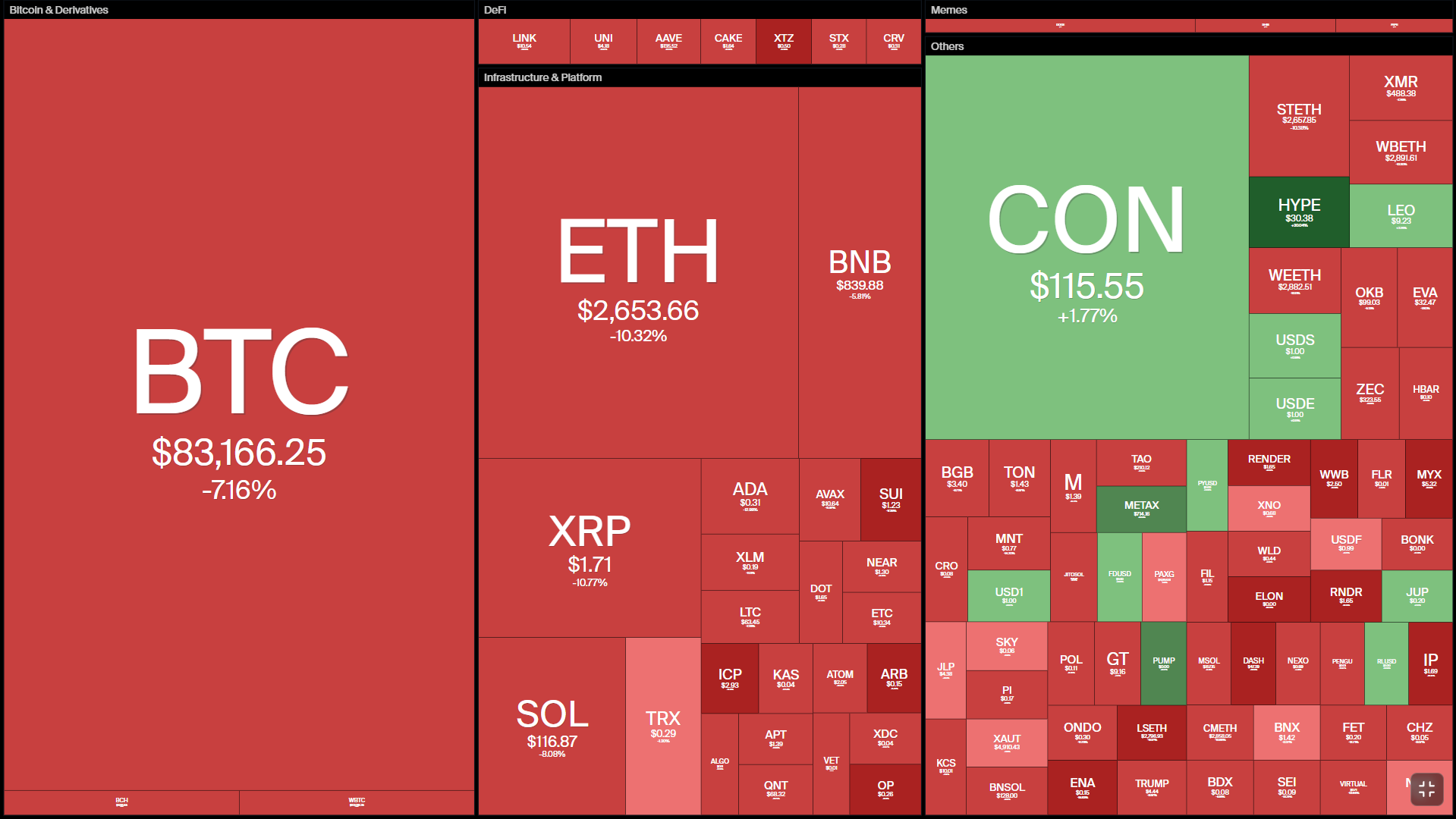
Bitcoin declined 7.16% over the week (Jan 25 close ~$87.9K -> Jan 31 ~$82.9K), while Ethereum fell 10.32% (~$2,892 -> ~$2,640). Both assets recorded their weekly highs on Jan 28—BTC near $90.25K and ETH around $3,040—before reversing sharply into Jan 30, when BTC briefly traded below $82K and ETH under $2,700. The failed mid-week reclaim set the tone for a risk-off close, with downside momentum concentrated late in the week rather than evenly distributed.
At the current stage, BTC is set for a 5.13% monthly decline, while ETH is projected for a 11.22% loss.
Market Structure
US spot ETF flows deteriorated meaningfully into the selloff. BTC ETFs recorded roughly $1.49B in net outflows across Jan 26–30, with the largest redemptions hitting Jan 29–30, while ETH ETFs saw about $326.4M in net outflows over the same window. The timing aligns with the sharpest leg lower in spot prices.
Crypto-Native Fundamentals
Derivatives positioning loosened as volatility rose. CoinGlass-tracked data showed significant liquidation clusters, including a reported ~$995M liquidation burst on Jan 29 and another stress window on Jan 30, which marked one of the week’s peak liquidation hours, with over $1.4B wiped out. Separately, a Coinbase–Glassnode update published during the week noted continued contraction in stablecoin supply, reinforcing a backdrop of tighter crypto-native liquidity rather than fresh risk deployment.
Among the top 100 cryptocurrencies, Hyperliquid's HYPE is the best weekly performer, with recent price surge stemming from a 90% reduction in upcoming team token unlocks, limiting new supply. The DEX achieved $1.78 billion in daily trading volume on Jan 29, and $935 million in open interest, driven by strong silver market activity and recent HIP-3 upgrades enhancing rewards for HYPE stakers and users.
Macro Context
Macro signals skewed restrictive. The Federal Reserve held rates at 3.50%–3.75% on Jan 28, while late-week commentary and data kept inflation sensitivity elevated, including December PPI rising 0.5% m/m, the strongest increase in several months. Political headline risk resurfaced on Jan 30, when Donald Trump nominated Kevin Warsh as the next Fed chair, a development widely interpreted as reducing uncertainty around Fed independence and supporting a firmer U.S. dollar.
Cross-Asset Comparison
The most violent cross-asset development occurred on Jan 30, when precious metals suffered a historic unwind. Gold plunged nearly 10% in a single session—its worst day since 1983—while silver collapsed more than 27%, marking its worst day on record. The move followed weeks of outsized gains and was widely described as a forced liquidation rather than a gradual repricing. U.S. equities also closed lower that day (S&P 500 -0.4%, Nasdaq -0.9%, Dow -0.4%), though major indices are still on track to finish January in positive territory.
Against this backdrop, crypto underperformed both equities and metals on a weekly basis: unlike gold and silver, which had surged earlier in the month before their late-January crash, BTC and ETH failed to capture a sustained defensive or momentum bid. The data supports a characterization of crypto as liquidity-sensitive risk exposure during the week, rather than a beneficiary of either inflation hedging or safe-haven flows, with attribution across macro, leverage, and ETF dynamics remaining mixed rather than singular.
Policy pressure and regulatory frameworks
Donald Trump announced plans on Jan. 30, 2026 to nominate Kevin Warsh as the next chair of the Federal Reserve. Warsh previously served as a Fed governor from 2006 to 2011 and currently holds roles at the Hoover Institution, Stanford Graduate School of Business, and Duquesne Family Office. The nomination followed a sharp swing in prediction-market odds. Warsh’s prior remarks criticizing regulatory uncertainty drew attention from digital-asset observers, though no explicit crypto policy stance was outlined. The nomination remains subject to Senate confirmation.
The U.S. Senate Agriculture Committee advanced a crypto market structure bill on Jan. 29 by a 12–11 party-line vote, marking the first time such legislation cleared a Senate committee. The bill would expand the Commodity Futures Trading Commission’s authority over large portions of the crypto market and address jurisdictional overlap with the Securities and Exchange Commission. Democratic lawmakers opposed the bill, citing concerns tied to Trump’s personal crypto interests. Public comments from SEC Chair Paul Atkins and CFTC Chair Mike Selig emphasized the need for clearer regulatory frameworks, and a White House meeting scheduled for Feb. 2 was described as an attempt to restart stalled legislative discussions.
Exchange infrastructure and protocol resilience
Binance said it is converting its Secure Asset Fund for Users into Bitcoin over a 30-day period, reallocating roughly $1 billion from stablecoins. The exchange committed to restoring the fund if balances fall below $800 million and said assets are held through regulated custody infrastructure in Abu Dhabi Global Market, with on-chain verification available.
The same disclosure revisited an October derivatives liquidation event totaling approximately $19 billion. The episode was described as macro-driven rather than an exchange failure, with most liquidations occurring before any internal system degradation. Temporary transfer disruptions and index deviations were acknowledged during periods of thin liquidity, and monitoring thresholds and system capacity were adjusted afterward.
Ethereum developers outlined ongoing work to strengthen long-term network security, including preparation for future quantum computing risks and improvements to censorship resistance. Efforts include multi-client devnets, a dedicated research team, and $2 million in cryptographic incentive programs. Estimates place the network at roughly 20% progress toward full post-quantum resilience. Separately, unclaimed restitution funds from the 2016 DAO hack — estimated near $200 million — are being redirected into a DAO Security Fund, with staking revenue intended to support protocol security initiatives.
Institutional crypto products: ETFs, staking, and structured exposure
Institutional crypto investment products continued to expand beyond spot Bitcoin exposure into income strategies, staking, altcoins, and commodity-linked instruments.
BlackRock launched a Bitcoin Premium Income ETF using covered-call option strategies, allowing a portion of Bitcoin exposure to generate cash premiums. BlackRock’s flagship IBIT Bitcoin ETF holds approximately $69.2 billion in net assets.
Grayscale introduced its Bitcoin Mini Trust ETF on Morgan Stanley’s E*TRADE platform, extending regulated Bitcoin access to financial advisors overseeing trillions in client assets. VanEck launched the first AVAX spot ETF on Nasdaq, while Grayscale advanced filings for a Sui-based ETF that incorporates staking considerations.
Bitwise registered a trust tied to a potential Uniswap ETF, and Grayscale amended its spot XRP ETF filing with updates to pricing methodology. In Europe, 21Shares launched a liquid-staking Solana ETP, combining staking rewards with price exposure.
Alongside crypto-native assets, the first tokenized gold ETF units backed by physical gold debuted on the Hong Kong Stock Exchange, with issuance and tracking anchored on Ethereum while custody remains in local vaults. The launch marked a direct intersection between traditional commodities and blockchain issuance infrastructure.
Stablecoins and tokenized settlement rails
Tether disclosed holdings of nearly 140 metric tons of physical gold valued at roughly $24 billion, primarily backing its tokenized gold product. The company described acquiring one to two tons per week and outlined plans for reserve trading and arbitrage, alongside new hires of senior gold traders and equity stakes in precious-metals firms.
Tether also launched USAt, a U.S.-focused stablecoin issued through Anchorage Digital with an initial $10 million deployment on Ethereum, with distribution planned through centralized trading platforms.
Fidelity said it will begin an Ethereum-based trial of its Fidelity Digital Dollar via its national trust bank, which received conditional approval from the U.S. Office of the Comptroller of the Currency in December 2025. Issuance limits and reserve mechanics were not disclosed, though executives framed stablecoins as foundational settlement infrastructure aligned with the GENIUS Act framework.
In the Middle East, the Central Bank of the UAE approved USDU as the first USD-backed stablecoin registered under its Payment Token Services Regulation. USDU is backed one-to-one by dollars held onshore with domestic banks and subject to monthly attestations, with restrictions preventing use as general-purpose retail money.
Corporate treasuries and balance-sheet positioning
Strategy disclosed the purchase of 2,932 BTC for $264.1 million at an average price of $90,061, bringing total holdings to 712,647 BTC acquired for approximately $54.19 billion. January purchases exceeded the company’s combined acquisitions from the prior four months.
BitMine Immersion reported Ethereum holdings of 4,243,338 ETH after acquiring additional ETH in January, valuing the position at roughly $12.3 billion and representing about 3.52% of circulating supply. The company also disclosed substantial cash holdings and equity investments.
Metaplanet approved a ¥21 billion capital-raising plan through new share issuance and stock acquisition rights to fund further Bitcoin purchases, partial debt repayment, and general corporate purposes. Roughly ¥14 billion is earmarked for Bitcoin acquisitions. Shares declined about 4% following the announcement, attributed to dilution concerns.
Market structure, flows, and yield products
Robinhood’s CEO said the 2021 GameStop trading restrictions could have been avoided if equities were issued and settled on blockchain infrastructure, citing legacy clearing systems and collateral requirements as the core constraint. One-day settlement reforms have since been implemented, though regulatory clarity was described as the key barrier to deploying tokenized equities at scale.
WisdomTree expanded its digital fund infrastructure to Solana, enabling on-chain issuance and transfer of diversified investment products with institutional and retail access via stablecoins. The move coincided with projections that tokenized real-world assets in the Gulf region could grow substantially over the coming decade.
Crypto investment products recorded approximately $1.73 billion in net weekly outflows as of Jan. 26, with Bitcoin and Ethereum products leading redemptions. Select altcoin products posted modest inflows, while U.S.-listed vehicles accounted for the majority of withdrawals.
Kraken launched DeFi Earn, offering access to on-chain lending vaults with yields up to 8%, sourced from borrower demand rather than token incentives. Bitwise separately joined Morpho as a vault curator, targeting up to 6% yield on USDC through over-collateralized lending strategies with centralized risk oversight.
Top Weekly Altcoin Gainers and Losers
Gainers:
Hyperliquid HYPE (+29.66%)
Pump.fun PUMP (+9.56%)
UNUS SED LEO LEO (+3.42%)
Jupiter JUP (+2.05%)
Losers:
Story IP (-32.92%)
Dash DASH (-28.38%)
MYX Finance MYX (-18.10%)
Render RENDER (-17.97%)
Sui SUI (-17.49%)
This article has been refined and enhanced by ChatGPT.


