




 USD
USD
Coin360 Weekly Dispatch | Crypto Market Updates & Highlights | March 22-28, 2026


Trade Like You Mean It: The COIN360 Perp DEX Is Live
We’ve launched the all-new COIN360 Perp DEX, built for traders who move fast!
Trade 130+ assets with up to 100× leverage, enjoy instant order placement and low-slippage swaps, and earn USDC passive yield while climbing the leaderboard. Your trades deserve more than speed — they deserve mastery.
Weekly Crypto Market Performance
Period: March 22-28, 2026
Total crypto market cap: $2.27T
Crypto Fear & Greed Index: 12 (Extreme Fear)
BTC.D: 58.35%
Price action
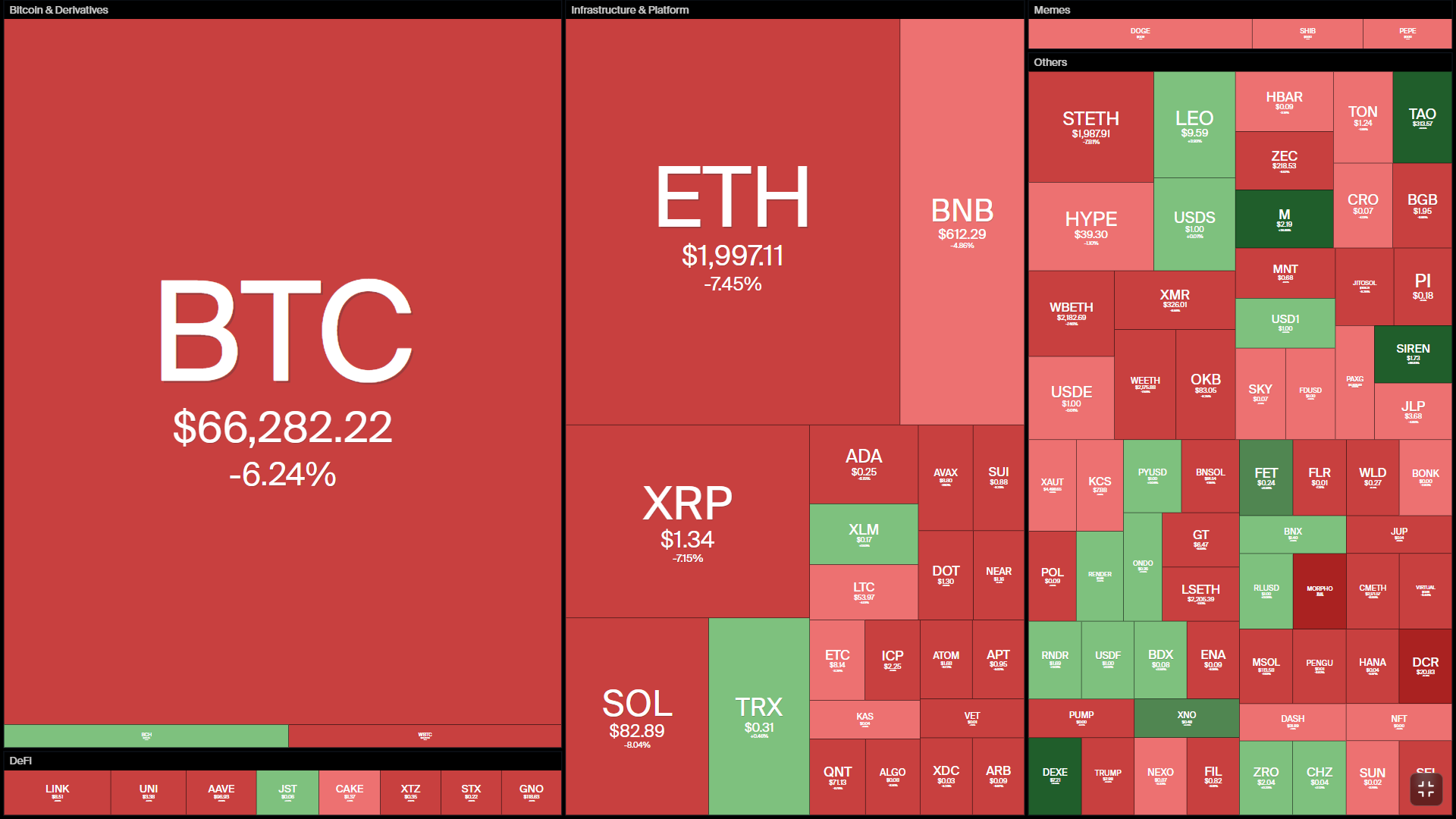
BTC and ETH both ended lower after failing to hold an early-week relief rally, with BTC slipping about 6.24% and ETH about 7.45% from March 22 to March 28. Both assets broke higher on March 23 — BTC briefly traded up to $71,791 and ETH to $2,196 — but that move faded into a late-week reversal, leaving BTC near $66,500 and ETH near $2,000 by March 28.
Market structure / Crypto-native fundamentals
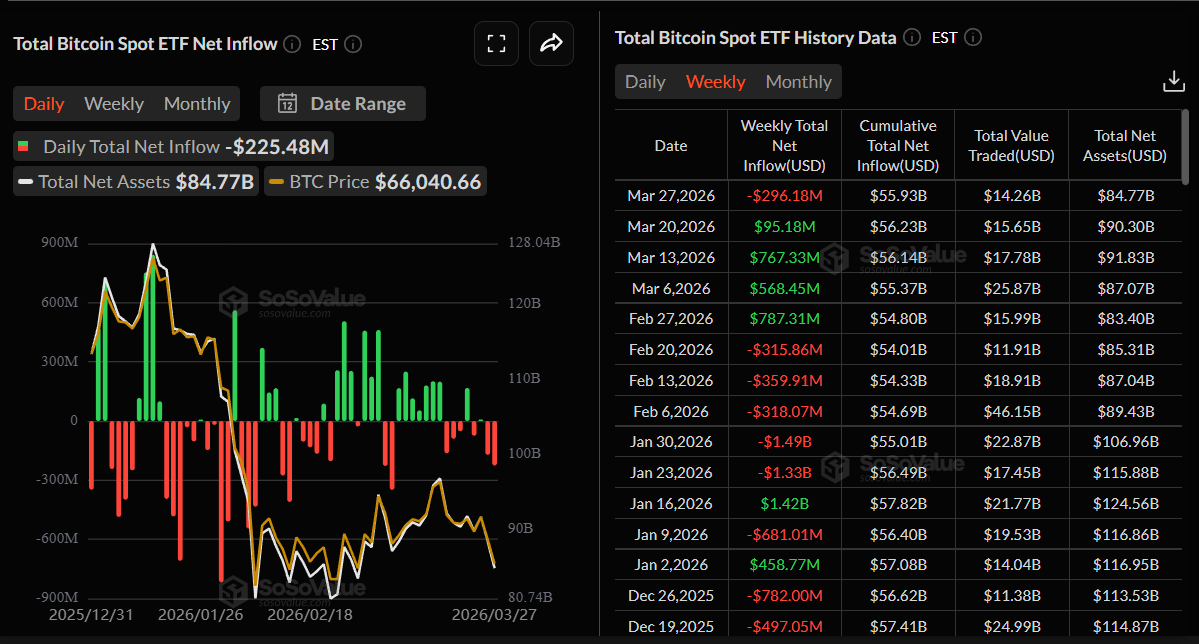
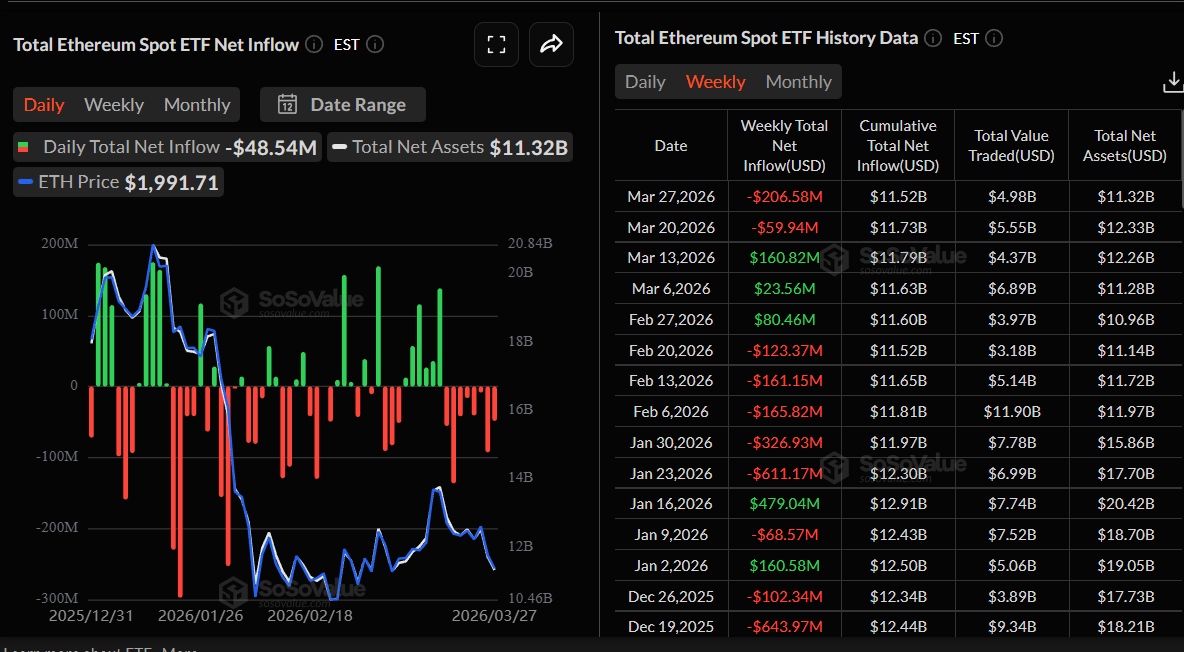
Attribution was shared, not singular. Early-week price support aligned with a reported $167 million net inflow into U.S. spot BTC ETFs on March 23, but that support weakened quickly as BTC ETF flows turned mixed-to-negative later in the week and spot ETH ETFs kept posting daily redemptions. ETH’s ETF picture was the cleanest bearish internal driver, with outflows reported each trading day from March 23 through March 27.
Crypto-specific policy news also turned less supportive at the margin on March 27, when David Sacks left the White House AI and crypto czar post after hitting the 130-working-day cap, though he stayed inside the administration as co-chair of PCAST. That meant continuity in policy access, but not continuity in title, while the broader CLARITY Act remained stalled and the Strategic Bitcoin Reserve was still described as seizure-funded rather than backed by open-market buying, limiting any immediate bullish read-through for BTC.
Separately, the Anthropic Claude Mythos leak likely deepened cybersecurity-risk fears across digital infrastructure markets, a relevant concern for crypto given the sector’s heavy dependence on software, custody, and smart-contract security.
Macro context / Cross-asset comparison
The dominant external driver was the Iran / Strait of Hormuz headline cycle. Crypto rallied when Trump delayed strikes on Iranian energy infrastructure on March 23. However, the impact then rolled over as de-escalation hopes faded and markets repriced higher oil, stickier inflation, and tighter policy risk by March 27, despite Trump extending the deadline for attacks on Iran’s power grid to April 6.
That backdrop hit risk assets broadly: by week’s end, the Nasdaq was down 4.64%, the S&P 500 and Dow were down about 3.42% and 1.76% respectively, while gold was slightly up by 0.48%, and oil had surged back toward $100 WTI and above $100 Brent.
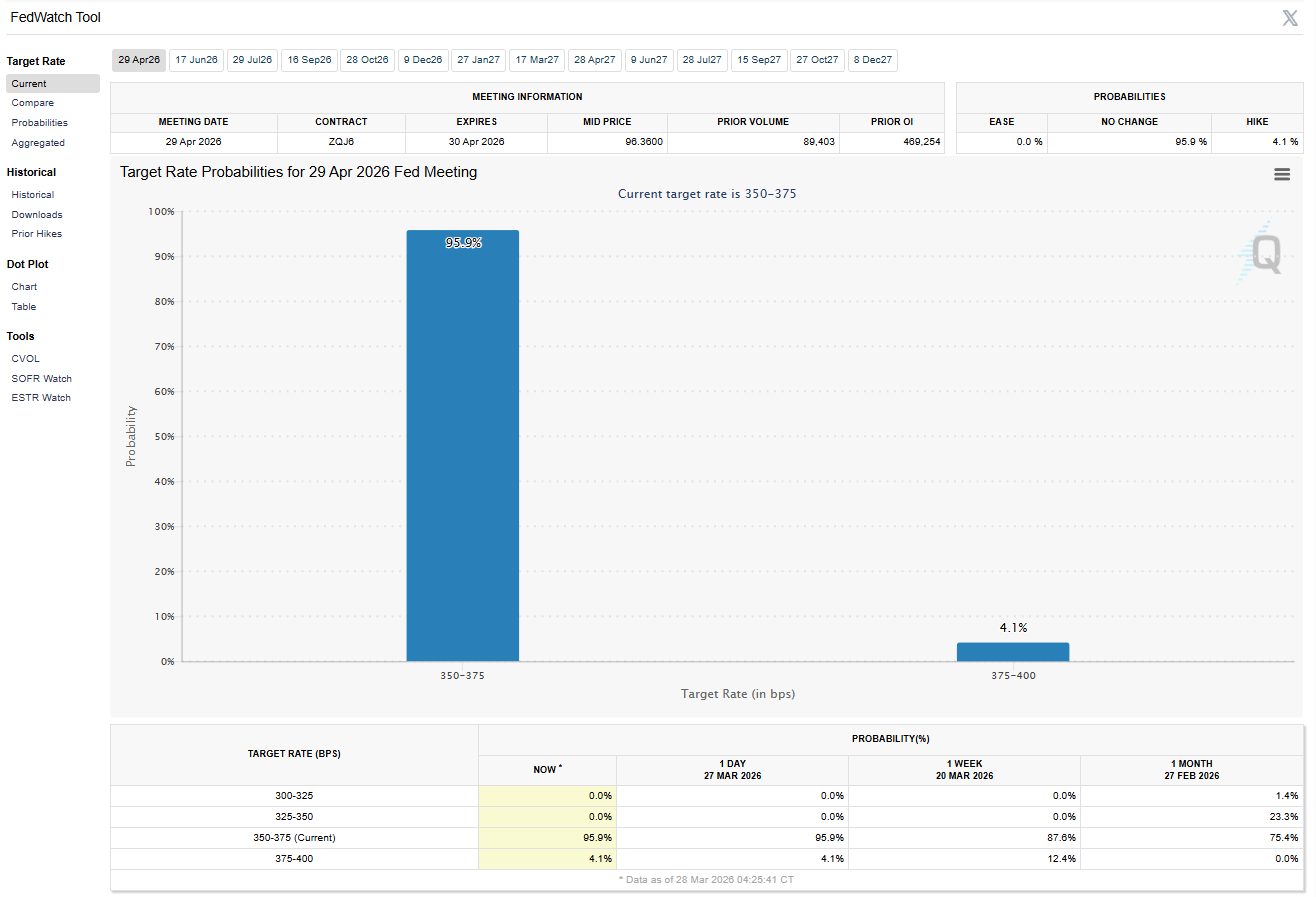
Macro pricing also turned more hostile during the week, with markets by March 28 assigning zero probability to Fed cuts in 2026 and a 4% chance of at least one rate hike, while Goldman lifted its 12-month U.S. recession probability to 30%.
Blackrock CEO and cofounder Larry Fink outlined a binary macro outcome from the Iran conflict: either reintegration or prolonged isolation. In a best-case scenario, Iran re-enters global markets, boosting oil supply and pushing prices toward $40, driving economic growth. In the worst case, sustained geopolitical tension keeps oil near $150 for years, triggering supply chain disruptions and a sharp global recession. He stresses there is no middle ground—markets will face either abundance-driven expansion or energy-driven economic contraction.
Market structure and tokenization
NYSE–Securitize deal targets 24/7 tokenized securities
NYSE and Securitize signed a March 24 memorandum of understanding to build infrastructure for issuer-sponsored tokenized securities on NYSE’s Digital Trading Platform. Securitize will act as the first digital transfer agent authorized to mint blockchain-native securities for corporate and ETF issuers. The framework covers issuance, ownership records and corporate actions while preserving traditional investor protections. It is designed for 24/7 trading, instant settlement, stablecoin funding and onchain recordkeeping, covering both tokenized versions of existing securities and natively issued digital securities.
Franklin Templeton deploys tokenized ETFs through Ondo
Franklin Templeton partnered with Ondo Finance to tokenize five ETFs for round-the-clock wallet-based trading outside the traditional brokerage model. The funds span growth equities, large-cap strategies, gold, high-yield credit and income equities. Ondo will acquire the underlying ETF shares and issue tokenized representations through a structure that passes through economic exposure without direct share ownership. Initial distribution targets Europe, Asia-Pacific, the Middle East and Latin America, while U.S. rollout remains subject to regulatory clarity.
Fidelity pushes SEC to widen broker-dealer crypto rules
Fidelity urged the SEC’s Crypto Task Force to clarify rules for broker-dealers handling crypto assets and tokenized securities on alternative trading systems. A core request is to let ATS operators rely on an issuer’s token classification instead of requiring each broker-dealer to perform a separate legal analysis. The proposal is aimed at reducing operational friction for firms bringing tokenized instruments into regulated markets and aligning the treatment of centralized and decentralized trading venues under clearer reporting and disclosure standards.
Invesco to take over tokenized Treasury fund USTB
Invesco will assume portfolio management of Superstate’s tokenized U.S. Treasury fund USTB, which has grown to about $967 million in assets. Superstate will continue running token issuance, settlement and transfer agency functions. The handover is expected in the second quarter of 2026, after which the fund will be renamed Invesco Short Duration US Government Securities Fund while keeping its ticker, smart contracts and token address. The move adds another major asset manager to the tokenized Treasury segment.
Consumer finance and tax policy
Coinbase and Better enable crypto-backed mortgage down payments
Coinbase and Better introduced a structure allowing homebuyers to use Bitcoin and USDC held on Coinbase to support down payments without selling the assets. The model pairs a standard conforming mortgage with a separate crypto-backed loan that supplies the down-payment cash. Borrowers can count verified crypto toward reserves, but the structure adds leverage because both loans must be serviced. The article also states that reserve recognition applies a 50% to 60% haircut and currently covers assets held on U.S.-regulated exchanges.
U.S. crypto tax draft favors stablecoins over Bitcoin
A bipartisan discussion draft would create a de minimis exemption for payment stablecoins, allowing small transactions below a defined threshold to avoid capital gains tax and reporting requirements. Bitcoin and other non-stable digital assets are excluded. That leaves ordinary Bitcoin transactions subject to property-tax treatment, including cost-basis tracking and taxable event reporting. The proposal narrows earlier efforts that sought broader crypto transaction relief and arrives as IRS Form 1099-DA reporting requirements are scheduled to take effect in January 2026.
Stablecoins and payments infrastructure
Tether hires KPMG for first full audit
Tether appointed KPMG for its first full independent financial statement audit and engaged PwC to prepare internal systems ahead of review. The audit will go beyond reserve attestations to cover assets, liabilities, internal controls and reporting frameworks. Tether disclosed roughly $193 billion in total assets against $186.5 billion in liabilities, leaving more than $6 billion in excess reserves. The move comes as U.S. stablecoin rules require large issuers above $50 billion in supply to produce annual audited financial statements under U.S. GAAP.
CLARITY Act draft hits Coinbase and Circle stocks
Coinbase and Circle shares fell sharply on March 24 after a revised CLARITY Act draft surfaced with language banning yield offered directly or indirectly on stablecoin balances. Circle fell about 18%, Coinbase more than 7% and Robinhood 4.7% during the session. The draft appears to focus on distributors rather than issuers. Circle’s business remains tied to reserve income rather than user yield, while Coinbase’s USDC rewards structure could face pressure if lawmakers finalize restrictions on stablecoin-linked distribution incentives.
Solana launches enterprise developer platform
The Solana Foundation introduced an enterprise-focused developer platform for financial institutions building blockchain products. The stack launches in sandbox form on devnet and is organized around issuance, payments and trading modules, with trading scheduled for later in 2026. Mastercard is using the platform for stablecoin settlement across selected networks starting with Solana. Western Union is building cross-border payment flows on it, while Worldpay is using the issuance and payments modules for merchant-facing onchain settlement and tokenized asset functionality.
Market behavior and institutional positioning
Bitcoin gains safe-haven edge over gold in JPMorgan report
JPMorgan’s March 26 report said Bitcoin showed safe-haven-like demand during geopolitical stress linked to the Iran war. The report contrasted Bitcoin’s inflows and stronger activity with weakness in precious metals. Gold fell about 15% month to date, while gold ETFs saw nearly $11 billion in outflows over the first three weeks of March. JPMorgan linked the divergence to institutional unwinding, weaker metals liquidity, rising rates and a stronger dollar, while Bitcoin benefited from continued inflows and improving momentum.
Corporate treasury and balance-sheet moves
Strategy and BitMine deepen crypto treasury concentration
Strategy disclosed a March 23 purchase of 1,031 BTC for roughly $77 million at an average price of $74,326, lifting total holdings to 762,099 BTC acquired for about $57.69 billion. The company also outlined a broader financing package totaling about $44 billion across common stock, preferred equity and convertible preferred shares. In the same report, BitMine said it bought 65,341 ETH during the prior week, taking holdings to 4,660,903 ETH, or about 3.86% of circulating supply, with a large share already staked.
H100 and Boyaa expand treasury plans
H100 Group signed a letter of intent to acquire Moonshot AS and Never Say Die AS through a bitcoin-for-bitcoin share exchange that would increase its treasury from 1,051 BTC to about 3,501 BTC if completed. Ownership in the combined entity would be based on contributed bitcoin. Boyaa Interactive separately approved a proposal allowing up to $70 million in additional crypto purchases over 12 months, pending shareholder approval. Boyaa already holds 4,092 BTC, 302 ETH and about 7,000,700 USDT.
MARA sells Bitcoin to reduce debt exposure
MARA sold 15,133 BTC between March 4 and March 25 for about $1.1 billion to repurchase $1.0 billion of its 2030 and 2031 convertible senior notes. The repurchases were executed at discounts to face value, capturing about $88.1 million in value before transaction costs and reducing convertible debt exposure by roughly 30%. After closing, about $924.1 million across the two note series is expected to remain outstanding. The transaction was framed as a balance-sheet move to reduce dilution risk and improve financial flexibility.
DeFi stress, exploits and prediction markets
Balancer shuts down Labs after exploit-driven reset
Balancer is winding down Balancer Labs and shifting to a DAO-led structure following a $128 million exploit tied to its V2 system. The incident stemmed from design-level vulnerabilities in composable pool logic and affected deployments across Ethereum, Polygon and Arbitrum. The restructuring reduces headcount from about 25 to 12.5 full-time equivalents, cuts the annual operating budget to $1.9 million, ends BAL emissions, removes veBAL and redirects 100% of protocol fees to the DAO treasury, alongside a capped buyback-and-burn program.
Resolv stablecoin USR collapses after unauthorized mint
Resolv’s USR stablecoin broke sharply on March 23 after a compromised private key enabled about $80 million in unauthorized minting. Roughly $25 million was extracted after the attacker swapped the unbacked tokens across multiple pools into other stablecoins and ETH. USR fell to $0.025 on Curve within 17 minutes. Operations were paused, around 9 million USR tied to the attacker was burned, and about $0.5 million was lost through redemption requests processed before the pause. Resolv said the collateral pool itself remained intact.
ICE finalizes $1.6 billion Polymarket investment
Intercontinental Exchange finalized a $1.6 billion commitment to Polymarket through a $600 million direct cash investment and planned purchases of up to $40 million in secondary shares, alongside a previously disclosed $1 billion investment made in October 2025. Prediction markets are described as having reached about $20 billion in monthly trading volume and more than 800,000 active wallets. At the same time, scrutiny is expanding, with at least 11 U.S. states taking action and California barring public officials from using non-public information to profit through prediction markets.
Regulation, enforcement and infrastructure security
Brazil allows seized crypto to fund police operations
Brazil enacted Law No. 15.358, creating a framework that allows authorities to seize digital assets linked to criminal activity and redirect forfeited crypto into public-security funding. The law treats crypto as property that can be confiscated even when it was not used exclusively for illicit purposes. It authorizes the use of seized funds for equipment, training and specialized law-enforcement missions with judicial approval. The law also expands powers to freeze, block and seize wallets, exchange accounts and related infrastructure, including coordination with foreign agencies.
Google sets 2029 deadline for post-quantum cryptography migration
Google set a 2029 deadline to complete its transition to post-quantum cryptography across its systems and infrastructure. The stated risks are “store now, decrypt later” attacks on encrypted data and future threats to digital signatures once a cryptographically relevant quantum computer exists. Google is integrating post-quantum protections into Google Cloud, Chrome and internal systems, and deploying ML-DSA into Android 17. The report also links that timeline to blockchain security, since Bitcoin and Ethereum depend on digital signatures for ownership and transaction validation.
Top Weekly Altcoin Gainers and Losers
Gainers:
siren SIREN (+85.18%)
MemeCore M (+36.21%)
DeXe DEXE (+16.17%)
Bittensor TAO (+15.51%)
Artificial Superintelligence Alliance FET (+6.65%)
Losers:
Decred DCR (-15.93%)
Morpho MORPHO (-14.96%)
Worldcoin WLD (-14.03%)
Sei SEI (-13.48%)
Polkadot DOT (-13.12%)
This article has been refined and enhanced by ChatGPT.


