




 USD
USD
Coin360 Weekly Dispatch | Crypto Market Updates & Highlights | March 29 - April 4, 2026


Trade Like You Mean It: The COIN360 Perp DEX Is Live
We’ve launched the all-new COIN360 Perp DEX, built for traders who move fast!
Trade 130+ assets with up to 100× leverage, enjoy instant order placement and low-slippage swaps, and earn USDC passive yield while climbing the leaderboard. Your trades deserve more than speed — they deserve mastery.
Weekly Crypto Market Performance
Period: March 29 - April 4, 2026
Total crypto market cap: $2.29T
Crypto Fear & Greed Index: 11 (Extreme Fear)
BTC.D: 58.66%
Price action & market structure
Bitcoin and Ethereum finished the March 29 to April 4 week modestly higher, with BTC up 1.12% and ETH up 2.58%, but both gave back part of their early-week strength after rallying into April 1 highs near $69.3K for BTC and $2.17K for ETH.
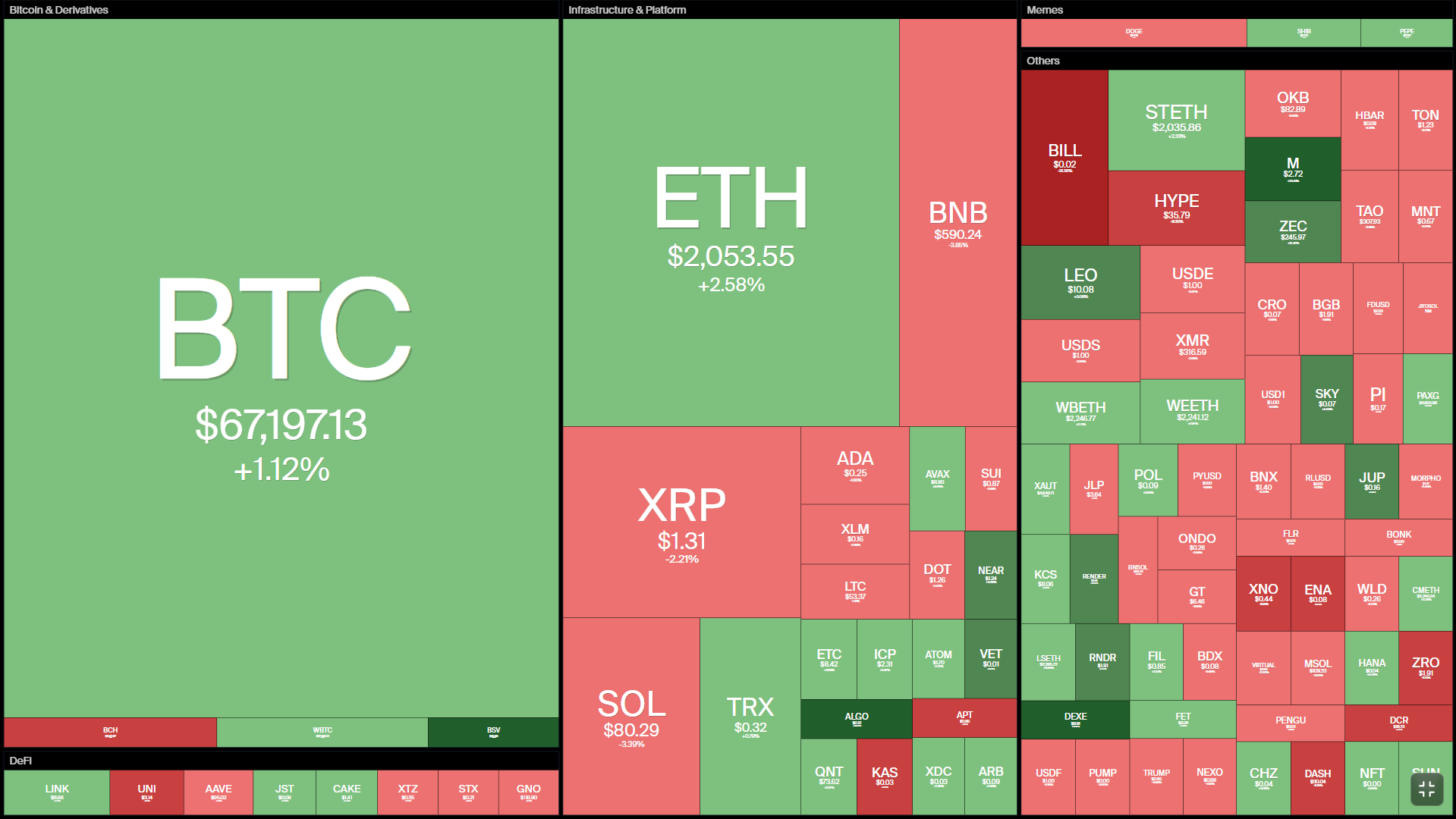
BTC March itself barely closed at +1.81%, a sharp fade from the over 11.47% average monthly gain — a number that flatters on paper but conceals a market still structurally underwater. Bitcoin closed Q1 2026 at $67,800, a devastating -22% quarterly loss, the worst first-quarter performance since 2018.
ETH outpaced BTC on a monthly basis, rising 6.97% and snapping a six-month losing streak dating back to September 2025. On a quarterly timeframe, ETH declined 29.26% in Q1 2026 — an improvement compared to the 45.41% drop recorded in Q1 2025.
Crypto-native fundamentals
Internal crypto flows were constructive for Bitcoin and weaker for Ethereum. U.S. spot ETF data for the trading days March 30 to April 2 show BTC ETFs with +$22.34 million net inflows versus ETH ETFs with -$42.15 million net outflows.
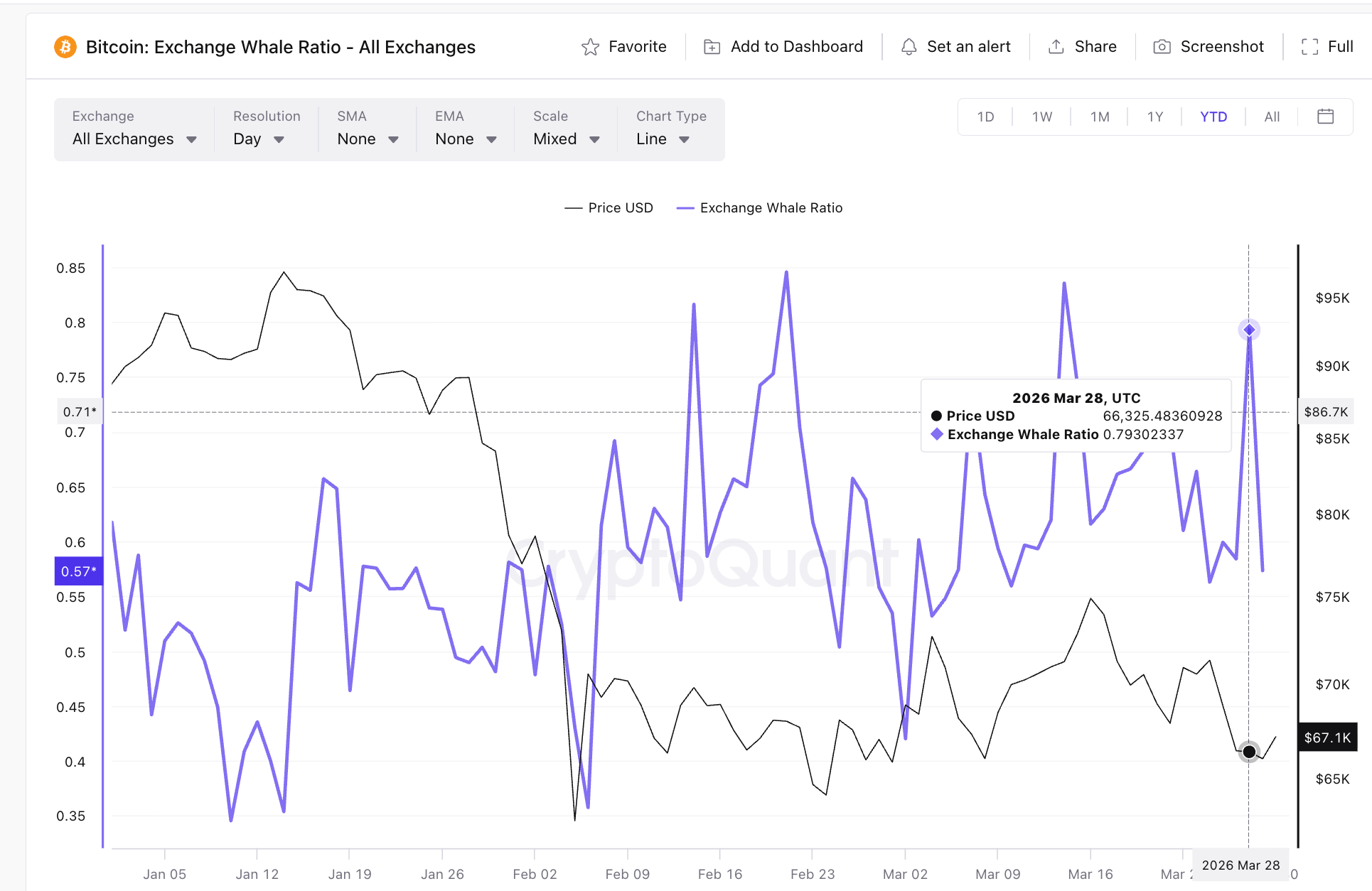
On-chain, the broader structural picture remained concerning heading into the week. The Exchange Whale Ratio surged to 0.79 by March 28 — with two notable spikes on March 14 and March 28 — indicating that large holders were sending a larger share of coins to exchanges relative to all participants, a consistent distribution signal throughout Q1 2026.
On the Ethereum side, developers are working on a solution for L2 fragmentation, and the Ethereum Foundation staked another $93 million in ETH during the week, nearly completing its planned 70,000 ETH staking target announced in February — a notable supply-reduction signal for long-term ETH observers, though it had no visible immediate price impact.
Macro context & cross-asset comparison
The dominant macro story this week was a convergence of two events: the one-year anniversary of Liberation Day (April 2, 2025) and the ongoing U.S.-Iran conflict now in its fifth week.
On April 1, hopes of de-escalation pushed oil lower and global equities higher. On April 2, that flipped hard after President Donald Trump said the U.S. would intensify attacks on Iran, sending WTI up more than 11% to $111.54 and Brent up nearly 8% to $109.03. On April 3, the March U.S. jobs report showed payrolls up 178,000 against expectations near 60,000, with unemployment at 4.3%, reinforcing the case for the Fed to stay cautious rather than turn dovish quickly.
In that context, crypto did not clearly decouple from traditional macro risk; BTC’s weekly gain trailed the S&P 500’s 2% and the Nasdaq’s 2.48%, while oil dramatically outperformed and gold sent a mixed signal by bouncing late, ending the week at +6.56% after a weak March.
Policy, access and market structure
401(k) crypto access proposal
The U.S. Labor Department proposed a rule on March 31 that would let fiduciaries consider alternative assets, including digital assets, in participant-directed retirement plans such as 401(k)s under a formal ERISA review process. The framework centers on documented evaluation of performance, fees, liquidity, valuation and complexity, replaces the department’s earlier crypto-specific caution with a neutral process standard, and does not require any plan to offer crypto.
The opening is potentially significant because U.S. 401(k) assets reached $10.1 trillion at the end of 2025, with public comments open until June 1, 2026. Any crypto exposure, if approved by fiduciaries, is expected to come mainly through diversified or professionally managed vehicles rather than direct participant purchases.
Stablecoin velocity and 2028 supply outlook
Standard Chartered kept its forecast for the stablecoin market to reach $2 trillion by the end of 2028 even as velocity climbed to roughly six monthly turns, double the pace of two years earlier. Faster turnover changes how supply growth should be modeled because payment use cases can expand transaction activity without requiring the same proportional increase in tokens outstanding.
USDC was described as the main driver of higher-frequency usage, especially after divergence from USDT began in mid-2024 and later accelerated on Solana and Base in October 2025 alongside early x402-linked AI-agent payments. USDT remained more closely tied to emerging-market savings demand.
Prediction markets widen their reach
Prediction markets expanded across sports, finance and streaming while jurisdictional conflict intensified in the United States. The CFTC sued Illinois, Arizona and Connecticut after Illinois moved against several platforms, arguing the states were interfering with federally regulated designated contract markets.
At the same time, Polymarket entered a multi-year partnership with LALIGA in the United States and Canada, expanded into commodities and equities using Pyth as the resolution source, and operated in a market where TRM Labs data showed monthly transaction volume rising from $1.2 billion in early 2025 to more than $20 billion. New consumer formats also appeared, including Pumpcade’s livestream products with markets lasting from 60 seconds to 30 minutes.
Security failures, stablecoin scrutiny and protocol risk
Drift exploit drains hundreds of millions
Drift Protocol was hit by a major exploit between April 1 and April 2, with reported losses of up to $285 million. The platform halted deposits and withdrawals and described the breach as unauthorized administrative access rather than a smart contract flaw. Onchain balances fell from $309 million to $41 million within minutes across more than 15 token types.
Drift later said the exploit used durable nonce-based pre-signed transactions that had been prepared in advance and executed rapidly, reportedly in under a minute after more than a week of setup. The stolen assets were largely swapped into USDC, bridged from Solana to Ethereum through CCTP, and at one point consolidated into 130,262 ETH.
Circle faces questions over USDC freezes
Circle came under scrutiny over how quickly it responded to illicit USDC movement linked to the exploit. ZachXBT alleged that Circle had failed to freeze about $420 million in illicit USDC flows since 2022 across 15 hack and fraud cases, and said that during the Drift incident the company had roughly six hours to act while more than 100 transactions were processed and $232 million was bridged out through CCTP.
Meanwhile, Circle is preparing cirBTC, a wrapped bitcoin token backed 1:1 by BTC, designed for institutions and set to launch first on Ethereum mainnet and Arc through Circle’s existing Mint infrastructure.
Google outlines quantum risk to major chains
Google researchers described a lower resource threshold for breaking elliptic-curve cryptography, estimating that such attacks could run on fewer than 500,000 physical qubits and complete in minutes under the architecture discussed in the paper. The report outlined a Bitcoin mempool scenario in which a private key could be derived in about nine minutes after a public key is revealed, with an estimated success probability just under 41%.
Roughly 6.9 million BTC were described as already exposed in wallets with revealed public keys. Ethereum was presented as having five distinct attack vectors spanning user accounts, admin control, protocol code, validator stake and data-availability systems. Mixed market reactions followed the report, including a 25% intraday jump in Algorand and industry commentary arguing that migration to post-quantum systems remains possible rather than implying immediate network-wide failure.
Enforcement, licensing and infrastructure
Coinbase advances trust and payment rails
Coinbase moved deeper into both federal supervision and open internet payments. The company said it received conditional approval from the Office of the Comptroller of the Currency to form Coinbase National Trust Company, a federally chartered trust entity intended to place its custody and market infrastructure business under a more unified federal framework.
The approval is not final and still depends on satisfying conditions tied to compliance capability, governance and risk controls. In parallel, Coinbase joined the Linux Foundation to launch the x402 Foundation, shifting the x402 protocol into open governance. The protocol revives the HTTP 402 “Payment Required” status code and was framed as infrastructure for internet-native and AI-driven payments.
KuCoin closes a U.S. legal chapter
KuCoin’s U.S. legal overhang narrowed after a federal court entered a consent order against operator Peken Global on March 30. The order imposed a $500,000 civil penalty and permanently barred the firm from allowing U.S. users to access its platform unless it registers with the CFTC.
Regulators said KuCoin let U.S. users trade commodity derivatives tied to Bitcoin, Ether and Litecoin between July 2019 and June 2023, with roughly 1.54 million U.S. participants generating about $110 million in derivatives fees. The civil result sits alongside the company’s January 2025 criminal resolution, which carried more than $297 million in penalties and required KuCoin to exit the U.S. market for at least two years.
Treasury balance sheets and institutional expansion
Treasury strategies split across firms
Corporate treasury strategies diverged sharply. Strategy disclosed that it halted its regular Bitcoin acquisition program between March 23 and March 29, marking its first weekly pause in just over a year, while still holding 762,099 BTC valued at about $51.6 billion against a cost basis near $57.7 billion.
Bitmine reported an Ethereum treasury of 4.732 million ETH, with 3,142,643 ETH actively staked. American Bitcoin said it held 7,000 BTC and that its bitcoin-per-share metric had more than doubled since its Nasdaq debut even as its stock fell below $1 and dropped more than 50% year to date.
Forced selling hits treasury holders
A separate treasury report captured the unwind side of the trade. Bitcoin treasury selling accelerated through Q1 2026 and into early April as public companies, miners and Bhutan reduced holdings, repaid debt, released collateral and raised cash while bitcoin traded around $66,500.
Riot sold 3,778 BTC during the quarter for $289.5 million. Empery Digital sold 370 BTC and used part of the proceeds to repay its term loan and release collateral. Genius Group exited its treasury after selling its final 84 BTC to repay $8.5 million in debt, and Bhutan was reported to have sold 3,103 BTC in total. Public treasury companies still held roughly 1,164,800 BTC, or more than 5% of bitcoin’s capped supply.
Franklin Templeton expands with 250 Digital deal
Franklin Templeton agreed to acquire 250 Digital and use the deal to form Franklin Crypto. The transaction includes the investment team and liquid cryptocurrency strategies managed on the 250 Digital platform, with Franklin Templeton also committing capital to those strategies.
The deal is expected to close in the second quarter of 2026, subject to definitive agreements, client consents and customary conditions, and uses BENJI tokens as payment consideration. Franklin Templeton reported about $1.8 billion in digital asset assets under management as of Dec. 31, 2025, compared with more than $1.7 trillion in firmwide assets under management as of Feb. 28, 2026.
Top Weekly Altcoin Gainers and Losers
Gainers:
Algorand ALGO (+50.94%)
DeXe DEXE (+23.84%)
MemeCore M (+22.40%)
Bitcoin SV BSV (+17.59%)
VeChain VET (+14.26%)
Losers:
Kaspa KAS (-11.41%)
Ethena ENA (-11.24%)
Aptos APT (-11.07%)
Hyperliquid HYPE (-9.31%)
Uniswap UNI (-7.57%)
This article has been refined and enhanced by ChatGPT.


