




 USD
USD
Coin360 Weekly Dispatch | Crypto Market Updates & Highlights | March 8-14, 2026


Trade Like You Mean It: The COIN360 Perp DEX Is Live
We’ve launched the all-new COIN360 Perp DEX, built for traders who move fast!
Trade 130+ assets with up to 100× leverage, enjoy instant order placement and low-slippage swaps, and earn USDC passive yield while climbing the leaderboard. Your trades deserve more than speed — they deserve mastery.
Weekly Crypto Market Performance
Period: March 8-14, 2026
Total crypto market cap: $2.38T
Crypto Fear & Greed Index: 16 (Extreme Fear)
BTC.D: 59.36%
Price Action
Bitcoin and Ethereum ended the week higher despite volatile macro conditions. BTC climbed roughly 3.83% week-over-week, rebounding from early-week levels near $67,000 to briefly reach an intraday high around $73,900 on March 13 before stabilizing near $71,000. ETH rebounded from a March 9 low at $1,938 to close the week back near $2,200.
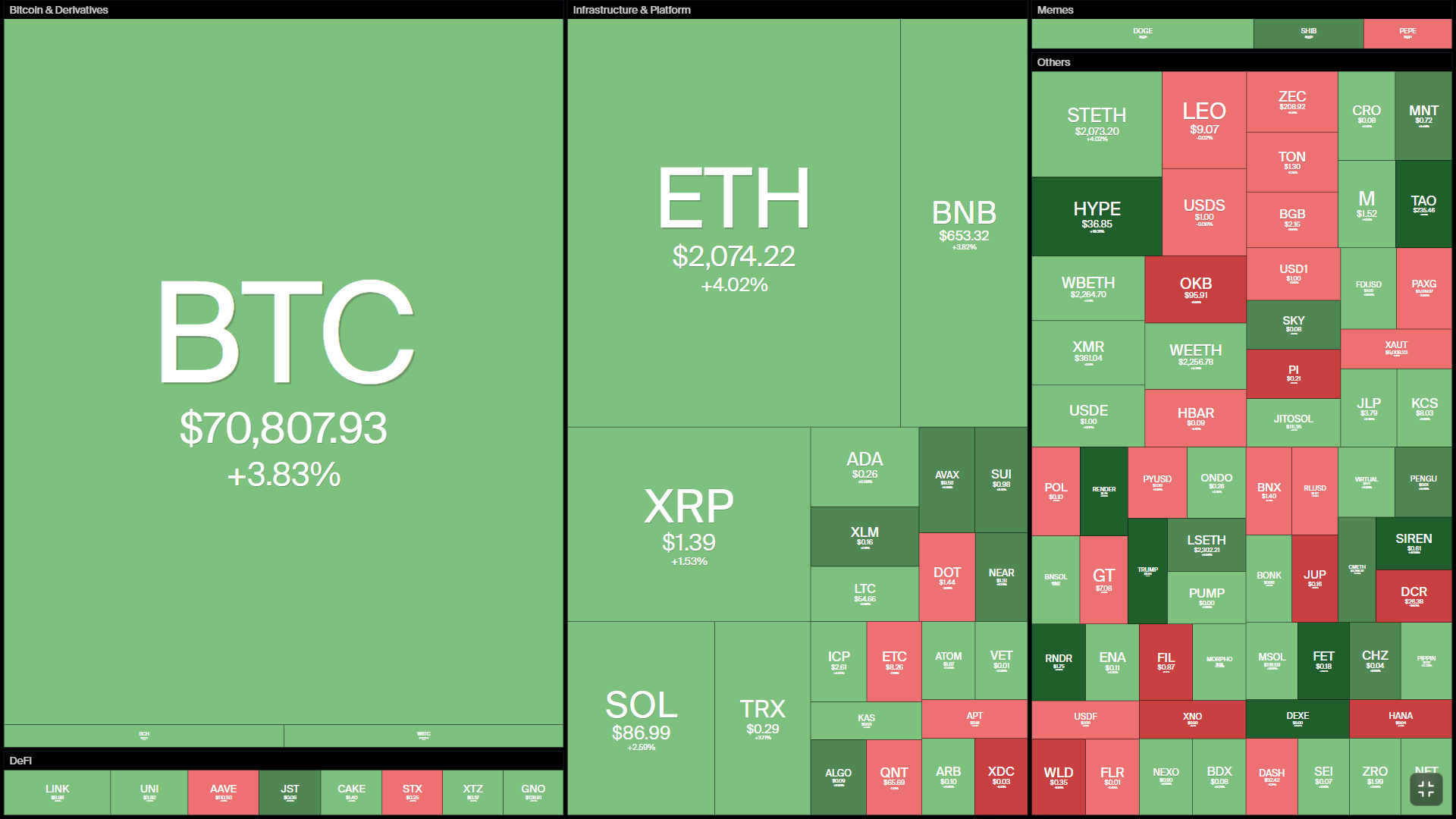
On March 9, Bitcoin reached a significant milestone by mining its 20 millionth coin, surpassing 95% of its capped supply of 21 million. With fewer than 1 million BTC remaining, the final coins are projected to be mined around 2140 due to the fixed issuance schedule that halves block rewards every 210,000 blocks.
Among large-cap altcoins, AI-related tokens were among the strongest performers during the week, extending a trend that has persisted throughout much of 2026. The outperformance followed renewed momentum in the artificial-intelligence sector after Nvidia unveiled its NeMoClaw framework for autonomous AI agents, a development that reinforced investor enthusiasm for agent-based computing systems capable of operating with minimal human input. The rally also reflected a broader market dynamic: capital rotation toward AI-themed assets continues even as analysts warn about potential overinvestment and bubble risks in the sector.
Market Structure
Support came from ETF demand, with U.S. spot Bitcoin ETFs taking in about $767.3M across the five trading days and spot Ethereum ETFs adding about $160.8M net despite a redemption hit on March 9.
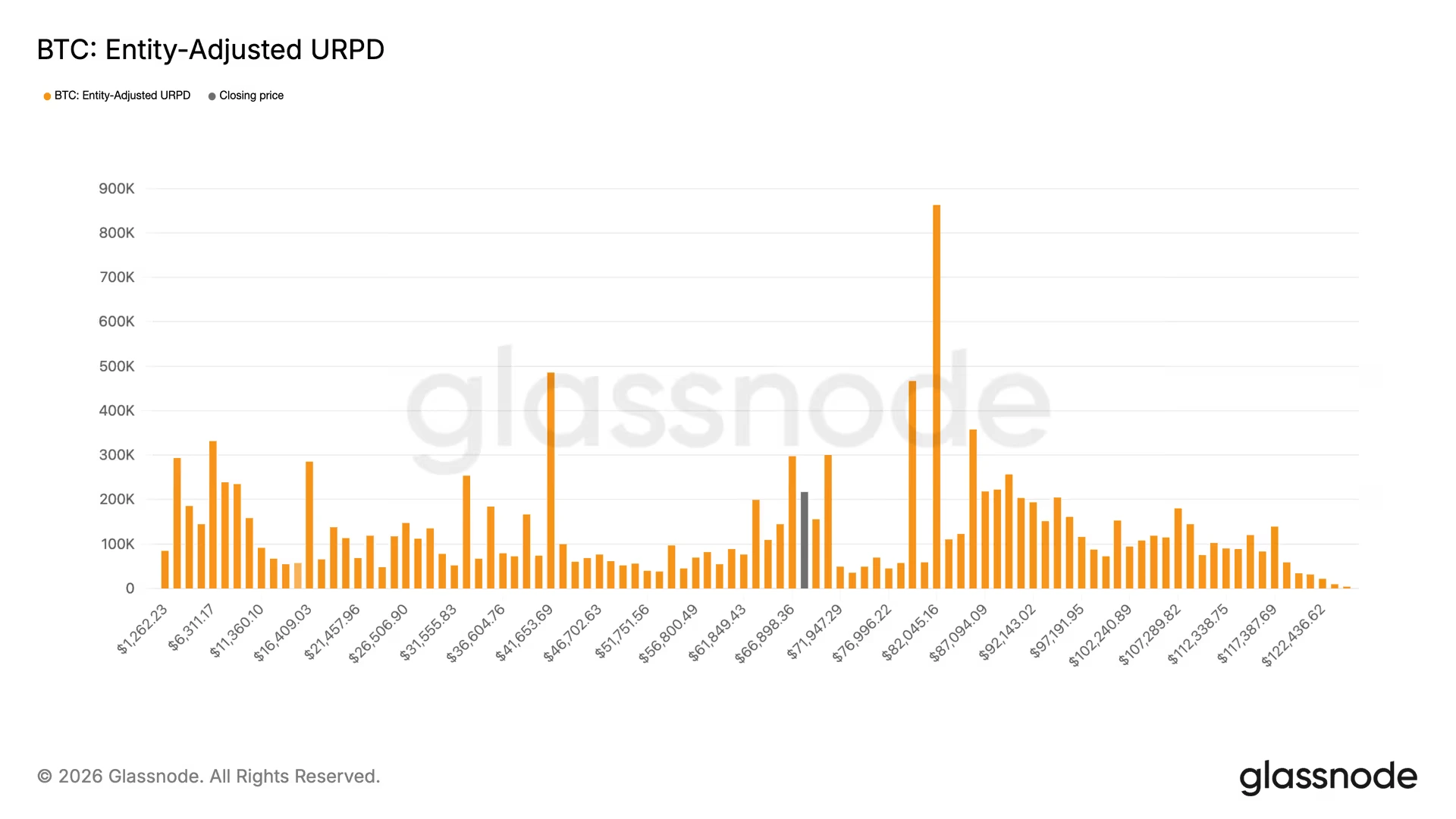
Crypto-native internals also leaned constructive, as total stablecoin supply added $2.9 billion to reach $315.7 billion over the week. Dip buying was evident in the heavy BTC turnover within the $60K–$70K band, with Glassnode data showing nearly 600,000 BTC changed hands during that period.
Crypto-Native Fundamentals
The crypto-specific backdrop improved even as leverage remained fragile. The early-week slide below $70K still triggered material liquidations, but the subsequent recovery suggests sellers were absorbed rather than amplified into a fresh cascade. That makes the week look less like a clean trend break and more like a reset in positioning that was later reinforced by real capital inflows.
Macro Context
The U.S.–Israel–Iran conflict entered its 15th day, escalating geopolitical risk and raising concerns about prolonged military engagement and its economic consequences. During the weekend, President Donald Trump warned that Iranian oil infrastructure on Kharg Island could be targeted, a site responsible for the majority of Iran’s crude exports and located near the Strait of Hormuz, which handles roughly 20% of global oil shipments.
The conflict intensified fears that expanded military operations could increase U.S. defense spending and energy-market disruptions, potentially reinforcing inflationary pressures and financial instability if oil supply were constrained or shipping routes disrupted.
In light of these escalating tensions, many businesses are reassessing their strategies and timelines. One notable example is TOKEN2049, which has decided to postpone its Dubai crypto conference to 2027 instead of this year.
Beyond geopolitics, broader financial markets were also grappling with structural risks. Investors increasingly scrutinized the $2 trillion private-credit market, where liquidity constraints and redemption pressure have raised questions about potential stress in leveraged lending structures.
Simultaneously, analysts continued to warn that the massive wave of AI-related investment and infrastructure spending may be creating distortions in equity and credit markets, raising concerns about whether an AI investment bubble could unwind if growth expectations fail to materialize.
Cross-Asset Comparison
Against TradFi, BTC and ETH outperformed on a weekly basis. U.S. equities finished the week lower: S&P 500 & Dow Jones both saw an over 2% loss while Nasdaq 100 dropped 1.15%, the dollar strengthened, and gold was down 2.93% by March 13, while silver also sold off on Friday. That relative performance argues for resilience, but not a slam-dunk decoupling call: correlation weakened during parts of the week, yet crypto was still trading in the shadow of the same inflation, oil, and rate-volatility regime hitting broader markets.
Regulation and Market Structure
SEC explores tokenized securities exemption while CLARITY Act stalls
U.S. regulators are examining a limited exemption that could allow certain tokenized securities trading activity while broader digital-asset legislation remains unresolved. The Securities and Exchange Commission is considering the exemption as part of discussions on how existing securities rules may apply to blockchain-based financial instruments.
The effort is occurring alongside coordination between the SEC and the Commodity Futures Trading Commission over digital-asset oversight. Meanwhile, progress on the CLARITY Act in Congress has slowed, leaving the broader legislative framework for crypto market structure undecided.
Binance files defamation lawsuit against WSJ over Iran-linked crypto transfers
Binance filed a defamation lawsuit against The Wall Street Journal after a report alleged that roughly $1.7 billion in cryptocurrency tied to Iranian networks flowed through the exchange and that an internal investigation into the activity was shut down. Binance disputes the claims, stating the report misrepresented its compliance processes and internal handling of the transactions. The lawsuit seeks damages and a retraction, arguing the allegations caused reputational harm.
The dispute centers on sanctions-related transaction monitoring and whether the exchange halted or continued internal probes into suspicious activity linked to Iranian entities using the platform.
U.S. Treasury acknowledges legitimate crypto mixer uses amid Tornado Cash retrial request
The U.S. Treasury acknowledged that cryptocurrency mixers can have legitimate uses as legal proceedings continue against a developer associated with Tornado Cash. The case includes a request for a retrial that could expose the developer to decades-long prison sentences.
The situation highlights ongoing legal debate around privacy tools and the regulatory treatment of software designed to obscure blockchain transaction histories.
Ripple pursues Australian financial license through BC Payments acquisition
Ripple is seeking regulatory approval in Australia through the acquisition of BC Payments, a move intended to expand its presence in licensed financial services infrastructure.
The company simultaneously announced a $750 million share buyback, placing the firm’s valuation around $50 billion under the terms associated with the program.
Institutional Adoption and Financial Infrastructure
Corporate Bitcoin and Ethereum treasuries expand
Public companies continued expanding digital-asset treasury strategies. Strategy acquired 17,994 BTC worth roughly $1.28 billion, increasing its total holdings to 738,731 BTC after financing part of the purchase with $377 million in preferred shares.
Ethereum treasury firm BitMine reported increasing its holdings to 4,534,563 ETH, including 3,040,483 ETH staked, generating an estimated $174 million in annualized staking revenue. Another public firm, SharpLink, reported a $734 million net loss while expanding its Ether holdings to roughly 868,000 ETH.
Mastercard builds global crypto payments network
Mastercard launched a blockchain payments network linking more than 85 crypto firms, including Binance, PayPal and Circle.
The system connects payment providers, exchanges and crypto infrastructure companies across more than 200 countries, enabling blockchain-based payment settlement through Mastercard’s existing global payments infrastructure.
Nasdaq and Kraken parent develop tokenized equities gateway
Nasdaq partnered with Kraken parent company Payward to develop infrastructure supporting tokenized equities trading.
The project aims to build a gateway for blockchain-based representations of stocks and targets the possibility of 24-hour equity trading by 2027.
Wells Fargo files trademark for “WFUSD”
Wells Fargo filed a trademark application for WFUSD covering services including digital-asset trading, blockchain payments, tokenization and decentralized finance infrastructure.
Trademark filings do not necessarily indicate a product launch but can signal areas where institutions are exploring future technology initiatives.
Hong Kong prepares first stablecoin licensing regime
Hong Kong authorities are preparing to issue the city’s first stablecoin licenses ahead of a planned March 2026 launch of the regulatory framework.
HSBC and Standard Chartered are among institutions positioned to receive authorization under the new regime.
Investment Products and Capital Formation
BlackRock launches staked Ethereum ETF
BlackRock introduced an exchange-traded fund designed to provide exposure to Ethereum while capturing staking yield generated by the network.
The ETF structure allows investors to hold Ether exposure through a traditional investment vehicle while earning staking rewards linked to Ethereum’s proof-of-stake mechanism.
Zcash Open Development Lab raises $25 million seed round
The Zcash Open Development Lab secured $25 million in seed funding to support development of privacy-focused crypto infrastructure.
The initiative brings together former Electric Coin Company team members under the leadership of Josh Swihart, with the funding aimed at ecosystem development tools and infrastructure.
Exchange Competition and Market Activity
Bullish surpasses Coinbase in spot trading volume
Crypto exchange Bullish recorded $76 billion in spot trading volume in February, surpassing Coinbase during the same period.
The volume figures were reported while Bitcoin traded between approximately $65,000 and $73,000, with geopolitical tensions in West Asia cited as part of the market backdrop referenced in the report.
Retail Participation and Speculative Markets
Gen Z drives speculative crypto activity across meme coins and prediction markets
Younger investors are increasingly concentrated in high-risk crypto segments, particularly meme coins and prediction markets. The meme-token sector has expanded to about $31.7 billion in market capitalization with roughly $575.8 million in daily trading volume, while 32% of Gen Z investors report participating in prediction markets, where trading volume reached $12 billion per month in 2025.
Brokerage data cited by Charles Schwab CEO Rick Wurster shows Gen Z investors are 45% more likely to begin investing by age 21 than millennials. Payment data also shows Gen Z accounts for 72% of global peer-to-peer crypto transfers, while U.S. ownership surveys estimate 50 million Americans hold Bitcoin compared with 37 million holding gold.
TRUMP memecoin jumps 50% ahead of Mar-a-Lago event
The TRUMP memecoin rose about 50% overnight as large holders accumulated tokens ahead of a planned gala event at Mar-a-Lago.
Market activity around the token increased as whales accumulated positions tied to the event.
Dogecoin activity rises after X Money announcement
Elon Musk confirmed April early access for the X Money payments platform, a payments feature connected to the social platform X.
Following the announcement, Dogecoin trading activity and price increased, reflecting market reactions tied to the upcoming payments rollout.
Security Incidents and On-Chain Risk Events
Violent “wrench attack” forces €900K Bitcoin transfer in France
A couple in France was forced to transfer €900,000 in Bitcoin during a home invasion carried out by attackers impersonating police officers.
The incident is part of a pattern of so-called wrench attacks, where physical threats are used to force crypto holders to surrender funds or private keys.
Whales lose millions through DeFi trade and transfer mistakes
Crypto whales experienced major losses after two on-chain incidents: a $50.4 million DeFi trading mistake and a $14.2 million Ethereum transfer error.
Both losses were recorded on-chain and illustrate how irreversible blockchain transactions can amplify the impact of operational mistakes.
Aave oracle glitch triggers $26M liquidation cascade
A pricing error involving the wstETH oracle feed triggered rapid liquidations on the Aave lending protocol.
The incorrect price data caused approximately $26 million in liquidations within about 15 minutes as automated liquidation mechanisms activated across collateralized positions.
DeFi Product Development
Lido launches EarnUSD vault with DAO backstop
Lido introduced EarnUSD, a stablecoin vault product designed to expand the protocol’s services beyond liquid staking.
The launch includes a $5 million DAO-funded backstop intended to support the vault’s operations as the protocol expands into additional decentralized finance services.
Top Weekly Altcoin Gainers and Losers
Gainers:
DeXe DEXE (+38.75%)
Bittensor TAO (+30.41%)
Render RENDER (+27.34%)
OFFICIAL TRUMP TRUMP (+26.73%)
Artificial Superintelligence Alliance FET (+21.19%)
Losers:
Filecoin FIL (-11.40%)
Pi PI (-10.90%)
Jupiter JUP (-10.15%)
Worldcoin WLD (-8.91%)
Decred DCR (-8.56%)
This article has been refined and enhanced by ChatGPT.


