




 USD
USD
Coin360 Weekly Dispatch | Crypto Market Updates & Highlights | April 12-18, 2026

Trade Like You Mean It: The COIN360 Perp DEX Is Live
We’ve launched the all-new COIN360 Perp DEX, built for traders who move fast!
Trade 130+ assets with up to 100× leverage, enjoy instant order placement and low-slippage swaps, and earn USDC passive yield while climbing the leaderboard. Your trades deserve more than speed — they deserve mastery.
Weekly Crypto Market Performance
Period: April 12–18, 2026
Total crypto market cap: $2.55T
Crypto Fear & Greed Index: 26 (Fear)
BTC.D: 59.77%
Price action
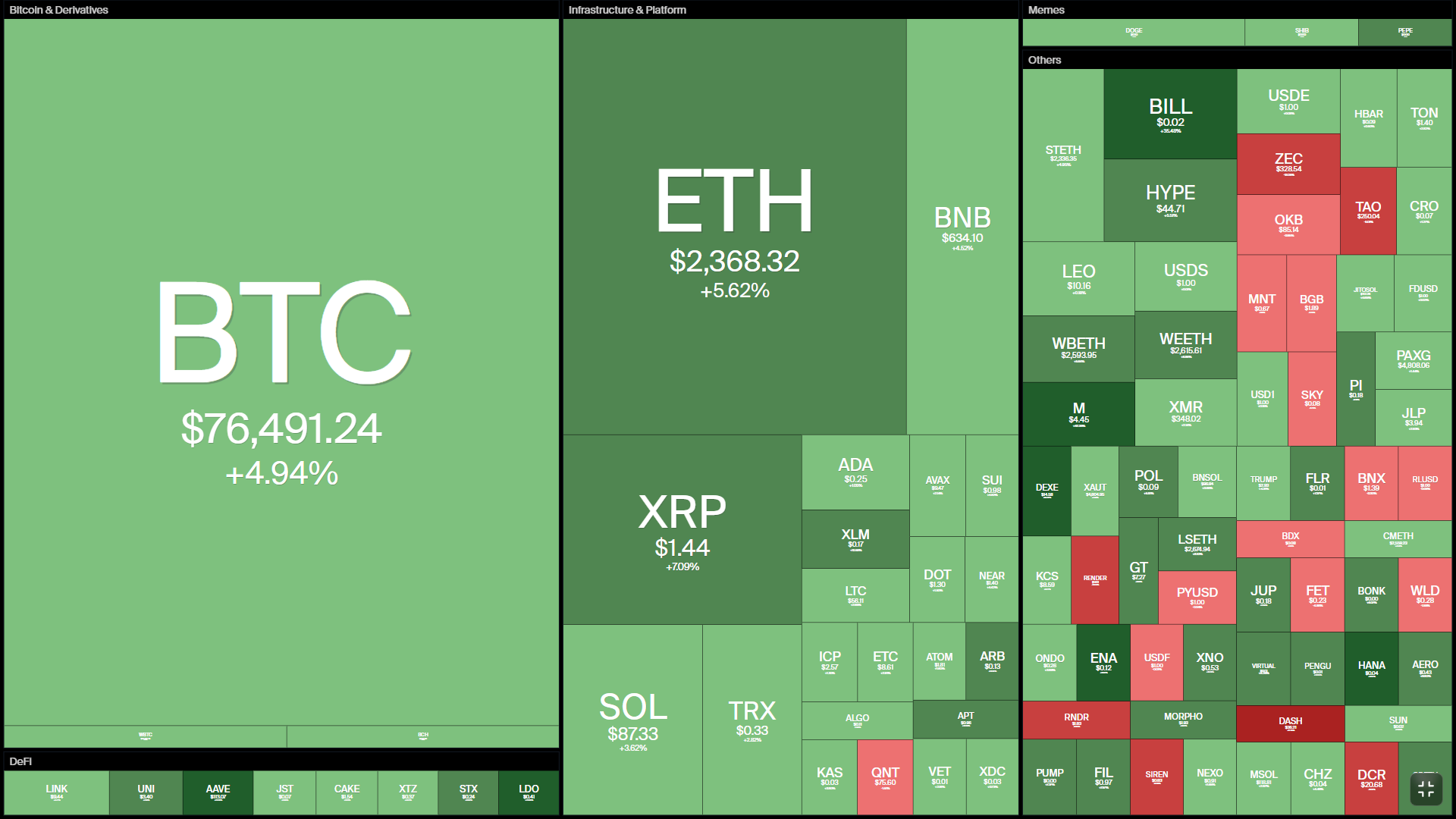
The market orchestrated a high-conviction recovery during the April 12–18 window, effectively neutralizing early geopolitical volatility. Bitcoin initially retraced to $70,900 following a U.S. naval blockade of the Strait of Hormuz, but ceasefire optimism subsequently countered the "escalation shock." Later in the week, BTC reclaimed the $75,000 threshold, ultimately appreciating 4.94% to finish near $78,080.
Ethereum increased 5.62% to $2,380, decisively shattering the $2,200 resistance level that had previously constrained price action. This pivot from distress to a $1.33 trillion BTC market cap underscores robust liquidity absorption and a material improvement in mid-month technical sentiment.
Market structure and crypto-native fundamentals
Attribution was shared, not singular. U.S. spot BTC ETFs absorbed about $996.4 million from April 13-17 and spot ETH ETFs added about $275.8 million. ETH also had a cleaner crypto-native support layer than BTC, with reported transaction activity up 41% week on week and a record 200.4 million transactions in Q1 2026.
Bitcoin funding rates dropped to their lowest levels since 2023, signaling heavy short positioning even as prices trended higher. Despite a sustained stretch of negative funding throughout March and April, BTC continued to grind higher, climbing from the low-to-mid $60,000s to around $77,000.
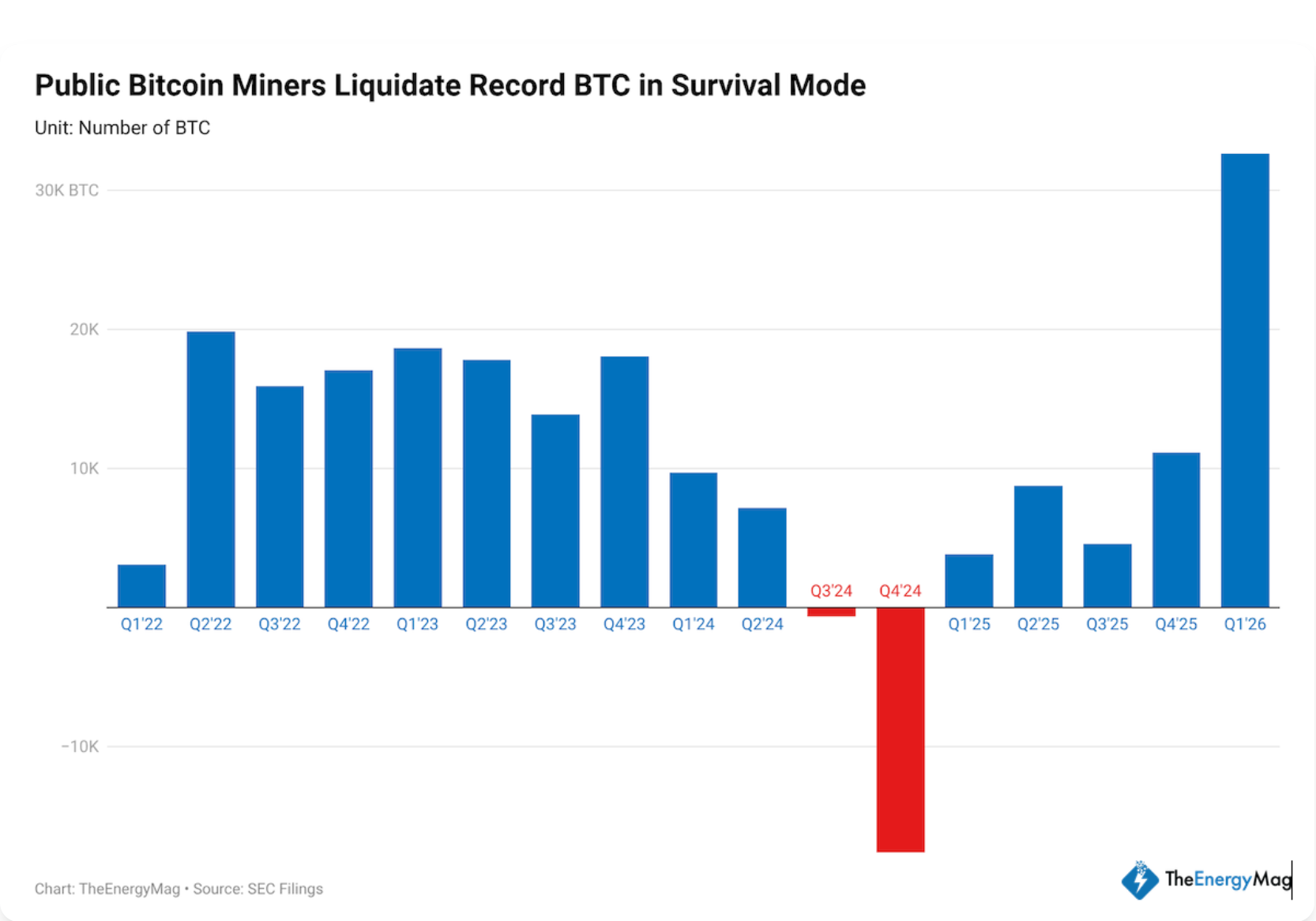
Meanwhile, publicly traded miners sold a record 32,000 BTC in Q1 2026, exceeding 2025 totals. Sales are driven by operational deficits as hashprice dropped to $33 PH/s, leaving 20% of miners unprofitable. While miner reserves fell to 1.8 million BTC, corporate treasuries continue strategic acquisitions despite rising energy costs and price volatility.
Macro context and cross-asset comparison
Macro still ran the board. Early-week support came from softer-than-feared March PPI, but inflation remained elevated enough to keep the Fed cautious. The dominant late-week catalyst was geopolitical: once Iran said the Strait of Hormuz was open, oil dropped below $89, rate-cut expectations revived, and risk assets ripped. Fed officials did not declare victory; Waller explicitly said a quick end to the war could reopen the door to cuts later in 2026, while a prolonged shock could embed inflation.
Against that backdrop, BTC and ETH moved in the same direction as gold’s 3.45% increase, the S&P 500’s 4.19% weekly rise, and the Nasdaq Composite’s 6.78% gain—the latter two both reached new all-time highs this week—while moving inversely to the sharp oil unwind.
However, sentiment can shift as Iran officially closed the Strait of Hormuz again after the US said the country would not end its blockade.
Bitcoin, Ethereum and Institutional Products
Bitcoin proposal would freeze unmoved coins over quantum threat
A draft proposal, BIP-361, introduces a staged transition requiring holders of legacy Bitcoin outputs vulnerable to quantum attacks to migrate funds into quantum-resistant formats or risk having those coins frozen at the protocol level. The proposal was assigned on Feb. 11, 2026, and publicly released on April 14, building on the still-pending BIP-360.
The framework outlines a five-year migration window, followed by restrictions on transfers to legacy addresses and eventual invalidation of signatures tied to unmigrated outputs. Debate around the proposal centers on whether enforced migration is preferable to leaving older coins exposed to potential quantum-based theft.
Strategy Nears BlackRock in Bitcoin as BitMine Tops 4% of Ethereum Supply
Strategy purchased 13,927 BTC between April 6 and April 12 for approximately $1 billion at an average price of $71,902, increasing total holdings to 780,897 BTC. These holdings represent roughly 3.8% of Bitcoin’s circulating supply, acquired at an aggregate cost of about $59 billion.
BitMine Immersion Technologies disclosed Ethereum holdings of 4,874,858 ETH, equivalent to 4.04% of circulating supply. Both disclosures highlight expanding corporate treasury exposure to digital assets, with Strategy focused on Bitcoin accumulation and BitMine emphasizing Ethereum scale and staking participation.
Goldman Sachs files for Bitcoin Premium Income ETF
Goldman Sachs submitted a registration filing on April 14 for the Goldman Sachs Bitcoin Premium Income ETF, an actively managed fund designed to generate income while maintaining exposure to Bitcoin-related assets. The fund would not directly hold Bitcoin.
At least 80% of assets are allocated to Bitcoin-linked instruments, including spot ETPs and associated options. The strategy relies on selling call options with an overwrite range between 40% and 100%, and may utilize a Cayman Islands subsidiary structure.
Exchange Infrastructure, Regulation and Policy
Kraken Expands U.S. Derivatives Push With Bitnomial Deal
Kraken’s parent company agreed to acquire Bitnomial to expand its presence in regulated U.S. derivatives markets. The move targets growth in spot margin trading, perpetual futures and options, while also enabling API-based access to tokenized equities, derivatives and fiat onramps.
Bitnomial holds CFTC licenses covering exchange, clearing and brokerage functions, forming the regulatory foundation for the expansion. Additional disclosures include a confidential U.S. IPO filing from November 2025, a $200 million secondary share purchase agreement with Deutsche Borse, and an extortion case involving rogue support staff that affected about 2,000 accounts without loss of customer funds.
Virginia Law Requires In-Kind Custody for Unclaimed Crypto
Virginia enacted House Bill 798, requiring unclaimed digital assets to be held in-kind rather than liquidated into cash. The law prohibits liquidation for at least one year after reporting and takes effect July 1, 2026.
Digital asset accounts are classified as abandoned after five years. The framework allows state administrators to appoint custodians for safekeeping and establishes a recovery process enabling owners to reclaim the original crypto assets rather than proceeds from forced sales.
SEC staff offers conditional broker relief for some crypto interfaces
The SEC’s Division of Trading and Markets issued a position on April 13 stating it would not object to certain crypto interface providers operating without broker-dealer registration under defined conditions tied to self-custodial transactions.
The position applies to interfaces such as websites, mobile apps and wallet-linked software. Requirements include operational neutrality, consistent fee structures and prohibitions on custody, execution, financing, or advisory functions. The relief is temporary and set to expire after five years unless extended.
Tether launches self-custodial wallet for USDT, Bitcoin payments
Tether launched a self-custodial wallet enabling direct payments in USDT, Bitcoin and tokenized assets. The wallet stores private keys locally and uses on-device signing, allowing users to transact without intermediaries.
The product supports human-readable identifiers and enables fees to be paid in the same asset being transferred. Initial support includes USDT, XAUT, USAT and Bitcoin across selected networks, with automated routing and network selection handled within the interface.
Kevin Warsh Fed filing reveals crypto-linked holdings and vast wealth
Financial disclosures tied to Kevin Warsh ahead of a Federal Reserve nomination hearing revealed assets exceeding $100 million, including exposure to crypto-related investments through structured vehicles.
Holdings span DeFi protocols, blockchain networks, Bitcoin infrastructure and Web3 companies. The disclosures highlight potential conflicts with Federal Reserve ethics rules adopted in 2022, which restrict ownership of crypto-related assets by officials and their immediate families.
Disputes, Security Incidents and Recovery Efforts
Justin Sun, WLFI Clash Deepens With Court Threat
A dispute between Justin Sun and World Liberty Financial centers on frozen token holdings and governance controls embedded in smart contracts. Allegations include undisclosed mechanisms allowing token freezing and reallocation, while counterclaims reject the accusations and point to prior actions taken by Sun.
Approximately 544 million WLFI tokens linked to Sun’s wallet were frozen following movements in September 2025, with a reported valuation of about $119 million at the time. Contract updates introduced blacklist and batch reallocation functions, and legal action is being considered.
CoW Swap DNS Hijack Prompts Frontend Shutdown Warning
A DNS hijacking attack targeted CoW Swap’s frontend, redirecting users to a malicious interface. Access to the official domain was suspended, and backend services and APIs were paused as a precaution.
Users were advised to revoke wallet approvals made after April 14. Estimated losses reached about $500,000, and a temporary alternative interface was deployed while the compromised domain remained locked.
Polkadot Hyperbridge Exploit Mints 1B DOT on Ethereum
An exploit affecting Hyperbridge’s Ethereum gateway contract allowed unauthorized minting of 1 billion DOT on Ethereum. The incident did not impact Polkadot’s native network or parachains.
Despite the nominal scale, actual extracted value was significantly lower due to liquidity constraints, with approximately 108 ETH converted. Additional tokens including ARGN, MANTA and CERE were also affected.
Ethereum Foundation program identifies DPRK-linked workers, recovers $5.8 million
A six-month security initiative identified more than 100 suspected DPRK-linked operatives working across crypto projects and recovered or froze over $5.8 million in assets.
The program reported more than 785 vulnerabilities and supported over 36 incident responses. Identified operatives were linked to 53 projects, with insider threat detection becoming a central focus of the effort.
Drift sets USDT relaunch after exploit and Tether-backed recovery plan
Drift outlined a relaunch plan following an April 1 exploit, introducing a recovery token representing claims on a compensation pool tied to future protocol performance. Support commitments total up to nearly $150 million, including contributions from Tether.
Reported losses stand at approximately $295.7 million. The relaunch includes a shift from USDC to USDT as the settlement asset. Meanwhile, some users have filed a class action alleging Circle’s failure to freeze stolen funds moved through cross-chain infrastructure.
Grinex halts trading after $13.7 million crypto exploit
Grinex suspended trading and withdrawals following a confirmed $13.7 million exploit affecting 54 wallets. A technical audit is underway with no timeline provided for restoration or compensation.
Stolen funds moved across multiple networks, beginning in USDT before conversion into other assets. The incident occurred amid a broader series of April attacks affecting multiple crypto platforms.
Adoption, Corporate Expansion and Market Structure
Pakistan Ends 2018 Crypto Banking Ban With Licensed VASP Rules
Pakistan lifted its 2018 crypto banking ban and introduced a regulated framework allowing banks to service licensed Virtual Asset Service Providers. Client funds must remain segregated in non-interest-bearing accounts denominated in local currency.
Banks are prohibited from holding or trading crypto assets directly. The framework includes a two-stage licensing process, AML and compliance requirements, Sharia alignment provisions, and penalties for unauthorized activity.
eToro to Acquire Zengo for $70 Million to Expand Self-Custody Push
eToro agreed to acquire self-custodial wallet provider Zengo in a deal valued at $70 million. The acquisition supports expansion into tokenized assets, derivatives and broader crypto services.
Zengo’s MPC-based architecture eliminates traditional private key management and serves more than 2 million users globally. The wallet will continue operating independently following the transaction.
Y Combinator Sends First $500,000 USDC Investment on Solana
Y Combinator completed its first fully onchain investment using USDC, sending $500,000 on Solana to Totalis. The transaction was executed in three transfers and reflects a new option for startups to receive funding in stablecoins.
The investment aligns with broader activity on Solana, which recorded $1.1 trillion in total economic activity during the first quarter of 2026 alongside growth in user and stablecoin metrics.
NFTs and Platform Shutdowns
Foundation Shuts Down After Blackdove Deal Fails
Foundation is permanently shutting down after a failed acquisition attempt by Blackdove. Core infrastructure has been taken offline, with no plans to relaunch the marketplace.
IPFS-hosted assets and metadata will be maintained for one year. Users are required to unlist NFTs and withdraw assets, concluding a platform that facilitated over $230 million in primary sales since its launch in 2021.
Top Weekly Altcoin Gainers and Losers
Gainers:
MemeCore M (+65.16%)
DeXe DEXE (+48.15%)
Ethena ENA (+29.81%)
Aave AAVE (+22.29%)
Arbitrum ARB (+12.76%)
Losers:
Dash DASH (-23.02%)
Zcash ZEC (-12.96%)
siren SIREN (-12.87%)
Render RENDER (-9.73%)
Bittensor TAO (-5.23%)
This article has been refined and enhanced by ChatGPT.


