




 USD
USD
Coin360 Weekly Dispatch | Crypto Market Updates & Highlights | January 18 - 24, 2026


Trade Like You Mean It: The COIN360 Perp DEX Is Live
We’ve launched the all-new COIN360 Perp DEX, built for traders who move fast!
Trade 130+ assets with up to 100× leverage, enjoy instant order placement and low-slippage swaps, and earn USDC passive yield while climbing the leaderboard. Your trades deserve more than speed — they deserve mastery.
Weekly Crypto Market Performance Overview
Period: January 18–24, 2026
Total crypto market cap: $2.99T
Crypto Fear & Greed Index: 25 (Extreme Fear)
BTC.D: 59.78%
Price Action
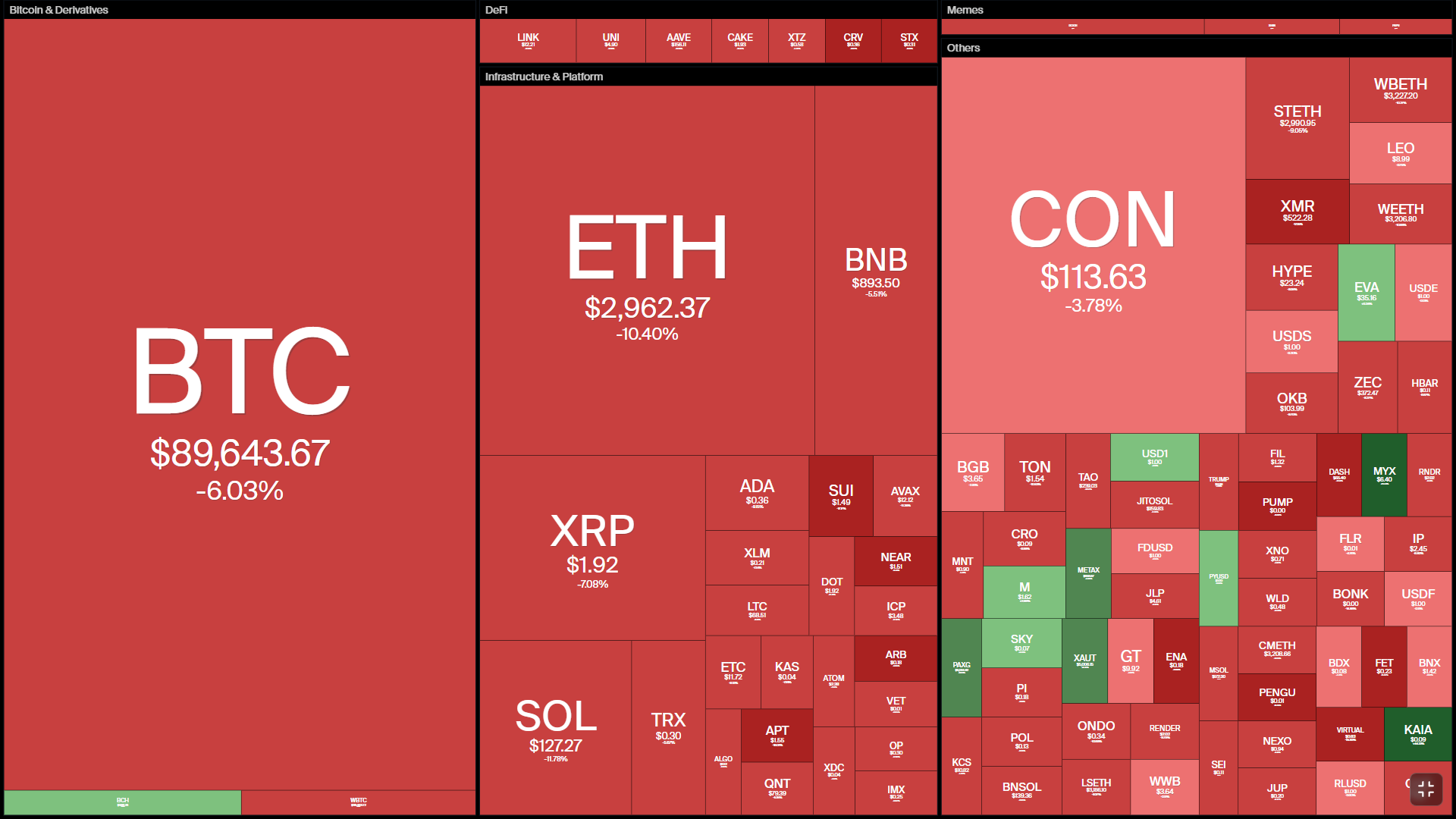
Bitcoin declined 6.03% over the week, sliding from $95,300 on Jan 18 to $89,643 by Jan 24. The bulk of the downside occurred early, with BTC posting its steepest daily loss on Jan 20 (-4.55%), before finding a local low near $87,560 on Jan 22 and moving into consolidation. Ethereum underperformed, falling 10.40% from $3,340 to $2,962, with its sharpest drawdown also on Jan 20 (-7.83%), followed by stabilization after a weekly low near $2,868. Most large-cap altcoins tracked ETH’s weakness, with broad double-digit losses across the high-beta segment.
Market Structure
US spot ETF flows remained decisively negative. Spot Bitcoin ETFs recorded approximately $1.33B in net outflows across sessions from Jan 20–23, while spot Ethereum ETFs saw roughly $611.17M in net redemptions over the same period. While ETF outflows and price declines coincided, attribution is shared, as the most violent spot price move preceded the full accumulation of weekly ETF selling.
Crypto-Native Fundamentals
Derivatives markets experienced a major forced deleveraging event. On Jan 20, heightened volatility linked to tariff threats triggered a violent shakeout that liquidated over $1.08 billion in crypto positions, wiping out positions for more than 182,000 traders across exchanges. This liquidation cascade aligned with the week’s intraday lows in BTC and ETH and materially amplified downside momentum.
Macro Context
Macro pressure intensified early in the week after Trump threatened tariffs on eight European nations in connection with Greenland negotiations, sharply increasing geopolitical uncertainty and driving a global risk-off response. This escalation coincided directly with the Jan 20 liquidation cascade and the week’s deepest crypto drawdown.
Trump’s Davos speech on Jan 23, however, marked a clear de-escalation. He ruled out the use of force regarding Greenland, framed tariffs as adjustable rather than punitive, downplayed recent equity weakness, reiterated pro-growth rhetoric, and emphasized U.S. ambitions to remain the “crypto capital of the world.” Following these remarks, crypto prices stopped trending lower and entered consolidation, indicating reduced tail-risk pressure rather than renewed risk-on demand. The speech acted as a stabilizer, not a catalyst.
Separately, the Bank of Japan held its policy rate at 0.75%, with communication interpreted as maintaining a tightening bias, reinforcing a cautious global liquidity backdrop.
On Jan 22, U.S. macro data reinforced a growth-with-friction backdrop. GDP growth for Q3 2025 was revised up to 4.4%, the fastest pace in two years. Labor conditions remained tight, with initial jobless claims steady at 200,000 and the four-week average falling to 201,500, the lowest in two years, while PCE inflation at 2.9% kept rate-cut expectations constrained, reinforcing expectations that the Federal Reserve would hold rates steady despite robust growth.
At the same time, Treasury market dynamics introduced a liquidity headwind. Reports showed Denmark, China, and India reducing U.S. Treasury holdings, with Denmark’s holdings falling to record lows and China’s dropping to a 17-year low (~$682.6B), while Japan and the UK increased exposure. Analysts warned that Treasury selling risks higher yields and tighter global liquidity, impairing collateral conditions and raising capital costs.
Cross-Asset Comparison
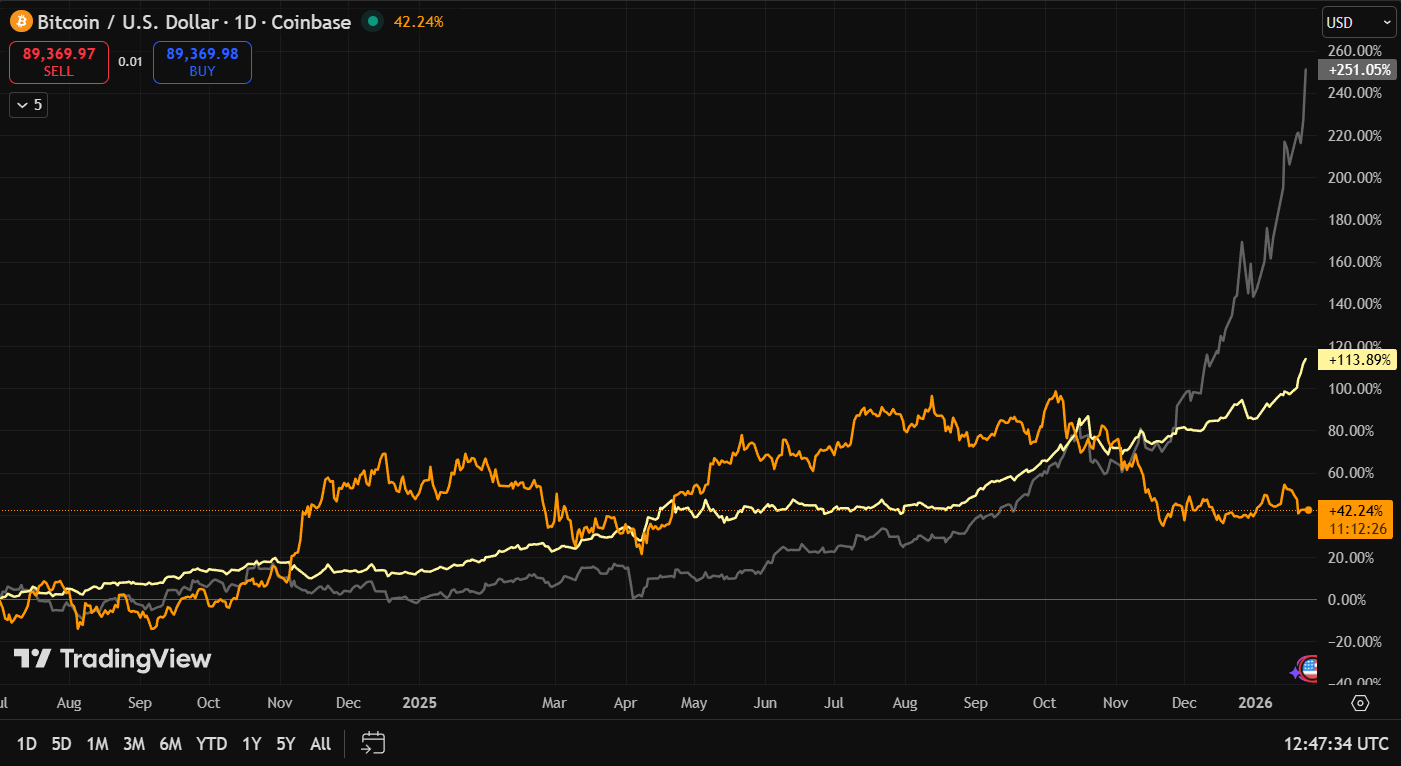
Traditional risk assets weakened modestly, with major U.S. equity indices ending the week slightly lower. In contrast, both gold and silver reached new all-time highs during the week, reflecting aggressive safe-haven inflows. Silver traded above $100/oz, while gold surged toward the $5,000 level. Crypto significantly underperformed both equities and precious metals, consistent with its positioning as a high-beta asset during periods of defensive capital rotation.
Liquidity Migration Into Prediction Markets
In mid-January, prediction markets posted record engagement, with platforms generating over $2.7 million in weekly fees and hitting an $814 million single-day trading volume milestone on Jan 19 — the highest on record for the sector. This activity pushed the segment’s share of overall spot-related crypto trading above 1% for the first time.
This shift mattered because capital that might otherwise sit in spot / futures exchanges was being deployed into prediction markets, especially for short-dated event contracts. When more capital rotates into alternative venues (with bespoke instruments and event-facing bets), order book depth on traditional spot and derivatives venues can thin, reducing market resilience. However, Galaxy Research noted that despite rising volumes and fees, prediction markets still face liquidity constraints.
Policy, Regulation, and Power Centers
Washington is positioning itself for a decisive phase in crypto regulation. President Donald Trump is aiming to sign a comprehensive crypto market-structure bill after Davos, while legislative momentum remains uneven. Disputes persist over stablecoin rewards, with banks opposing the GENIUS Act and crypto firms pushing for competitive issuance. Coinbase’s withdrawal of support slowed progress in the Senate Banking Committee, which had not scheduled a hearing as of late January.
The Senate Agriculture Committee released its market-structure bill on Jan. 22, 2026, followed by amendments on Jan. 23, including Sen. Michael Bennet’s Digital Asset Ethics Act proposing restrictions on crypto transactions by senior officials and lawmakers. Treasury Secretary Scott Bessent said on Jan. 21 the U.S. will stop selling seized bitcoin and instead route confiscated BTC into a Strategic Bitcoin Reserve, estimating holdings exceed 200,000 BTC. Additional developments include a planned CFTC-SEC joint meeting on Jan. 27, state-level Bitcoin proposals in Kansas and Oklahoma, the SEC dismissing its Gemini Earn case, and the DOJ dropping an OpenSea insider-trading case.
Binance submitted a MiCA license application in Greece on Jan. 23, positioning the country as a potential EU regulatory base ahead of MiCA enforcement deadlines. The filing comes as regulators highlight that many firms continue operating in the EU without a MiCA license. Binance is also exploring a return to stock-trading products roughly four years after discontinuing tokenized equities, alongside references to a BNB ETF filing that excludes staking and names Coinbase as prime broker and custodian. At Davos, co-founder Changpeng Zhao projected the possibility of a Bitcoin “supercycle” in 2026 without offering a price target.
Institutional Expansion and Market Infrastructure
UBS is preparing to offer cryptocurrency investing and trading to a limited group of private banking clients, reflecting rising demand among high-net-worth individuals. Access is expected to be selective rather than a broad rollout, expanding beyond UBS’s earlier constrained crypto offerings.
The move is being evaluated as part of broader platform integration following the Credit Suisse acquisition, with digital assets reviewed alongside other service adjustments across regions as UBS reshapes its wealth-management business.
The NYSE disclosed plans on Jan. 20, 2026 to develop a standalone tokenized securities platform offering 24/7 trading and on-chain settlement, pending regulatory approval. The venue would operate separately from the core NYSE market, supporting tokenized U.S. equities and ETFs, fractional shares, and stablecoin funding, eliminating the traditional T+1 settlement cycle. Industry reaction included comments describing the initiative as bullish for crypto and crypto exchanges.
Capital Markets, Treasuries, and Public Listings
Crypto firms are accelerating toward public markets as regulatory clarity improves and investor appetite returns. The weekly IPO recap highlights BitGo’s NYSE debut, Ledger’s potential multibillion-dollar U.S. listing, and CertiK’s ambitions to pursue a public-market strategy, framing custody, security, and infrastructure narratives as increasingly investable.
Strategy disclosed on Jan. 20, 2026 that it acquired 22,305 BTC for approximately $2.13 billion, increasing total holdings to 709,715 BTC. The purchase was financed primarily through equity issuance, with shares declining after the disclosure and bitcoin showing limited immediate price reaction. BlackRock participated in Strategy’s Bitcoin-linked preferred stock, positioned as an income-oriented structure.
On the Ethereum side, BitMine Immersion Technologies disclosed the purchase of 35,268 ETH over the prior week, valued around $110 million, bringing total ETH holdings to 4,203,036 ETH.
Laser Digital launched the Laser Digital Bitcoin Diversified Yield Fund SP on Jan. 22, 2026, a Cayman-domiciled, natively tokenized fund with on-chain share classes. The strategy targets more than 5% excess net returns versus bitcoin over rolling 12-month periods by combining long-only BTC exposure with arbitrage, lending, and options strategies. The product is aimed at institutional and accredited investors seeking yield alongside bitcoin exposure.
Galaxy Digital is preparing to launch a $100 million hedge fund in Q1 2026 focused on crypto tokens and fintech equities, structured for long and short positions. Up to 30% may be allocated to crypto, with the remainder targeting financial services stocks. The launch comes amid market weakness, with bitcoin trading roughly 28% below its October 2025 peak. Galaxy reported managing about $17 billion in digital assets and posting $505 million in profit in Q3 2025.
Tokenization, Onchain Finance, and Network Activity
Bermuda announced plans on Jan. 19, 2026 to build a fully onchain national economy, partnering with Coinbase and Circle to deploy digital-asset infrastructure across government agencies, financial institutions, businesses, and consumers. The initiative includes stablecoin-based payment pilots, tokenization tools for financial institutions, and nationwide digital-finance education, building on Bermuda’s 2018 Digital Asset Business Act.
35 major institutions, including BlackRock, JPMorgan, and Fidelity, have deployed live tokenized funds, deposits, equities, stablecoins, and payment infrastructure on Ethereum or Ethereum-linked networks. This expansion coincides with network metrics showing approximately 36.2 million ETH staked and exchange balances at a record low of 16.3 million ETH, while separate research indicated that part of record on-chain activity may be linked to spam-related address poisoning.
Vitalik Buterin outlined proposals between Jan. 19 and Jan. 22, 2026 focused on Ethereum staking, DAO governance, and decentralized social media. He proposed native Distributed Validator Technology allowing up to 16 keys per validator with minimal latency impact, criticized token-holder voting DAOs as vulnerable to capture and decision fatigue, and called for alternative governance models incorporating zero-knowledge tools and AI-assisted mechanisms. He also signaled plans to move fully back to decentralized social media during 2026.
Consumer Adoption, Tokens, and Usage Data
Survey data from OKX covering 1,000 Americans shows higher trust in crypto platforms among younger generations. About 40% of Gen Z and 41% of Millennials rated trust in crypto platforms at 7/10 or higher, compared with 9% of Baby Boomers. Confidence in crypto platforms increased in January 2026 relative to earlier in 2025, with younger cohorts more likely to plan increased crypto activity through 2026.
Payments data from CoinGate shows 644,578 crypto payments processed in the first half of 2025, with crypto settlements accounting for about 40.9% of merchant activity. Stablecoin usage shifted sharply, with USDC payments rising 337% year over year, and merchants increasingly retaining crypto revenues rather than converting immediately to fiat.
Solana Mobile launched its SKR token on Jan. 21, 2026, distributing nearly 2 billion tokens via an airdrop tied to its Seeker smartphone. SKR rose about 38% after launch, trading near $0.013. The token has a fixed supply of 10 billion, with an inflation schedule declining from 10% annually toward a long-term rate of 2%.
Legal, Political, and Market Incidents
Bitcoin briefly traded at $0 on Paradex on Jan. 19, 2026 after a database migration error corrupted internal pricing data during scheduled maintenance. The issue affected BTC, ETH, and SOL pricing and triggered automated liquidations before the platform rolled back chain state to restore balances. Paradex reported user funds were safe but did not disclose the number of affected accounts or total liquidated value.
Bloomberg figures cited show Donald Trump and his family accumulated approximately $1.4 billion in crypto-related assets since Jan. 20, 2025, representing about 20% of estimated net worth, with gains offset by losses elsewhere. Trump Media set Feb. 2, 2026 as the record date for a shareholder token initiative using Crypto.com infrastructure, positioned as a non-transferable rewards mechanism rather than equity.
Trump also filed a $5 billion lawsuit on Jan. 22, 2026 against JPMorgan Chase and CEO Jamie Dimon, alleging improper account terminations tied to his businesses. Claims include trade libel and breach of good faith, with JPMorgan denying political motivation and calling the suit meritless.
Top Weekly Altcoin Gainers and Losers
Gainers:
Kaia KAIA (+41.70%)
MYX Finance MYX (+25.85%)
PAX Gold PAXG (+9.04%)
Tether Gold XAUt (+8.71%)
Sky SKY (+4.00%)
Losers:
Ethena ENA (-20.45%)
Dash DASH (-17.29%)
Monero XMR (-17.08%)
Sui SUI (-17.08%)
Arbitrum ARB (-16.70%)
This article has been refined and enhanced by ChatGPT.


