




 USD
USD
Coin360 Weekly Dispatch | Crypto Market Updates & Highlights | April 26 - May 2, 2026


Trade Like You Mean It: The COIN360 Perp DEX Is Live
We’ve launched the all-new COIN360 Perp DEX, built for traders who move fast!
Trade 130+ assets with up to 100× leverage, enjoy instant order placement and low-slippage swaps, and earn USDC passive yield while climbing the leaderboard. Your trades deserve more than speed — they deserve mastery.
Weekly Crypto Market Performance
Period: April 26–May 2, 2026
Total crypto market cap: $2.57T
Crypto Fear & Greed Index: 39 (Fear)
BTC.D: 60.97%
Price action
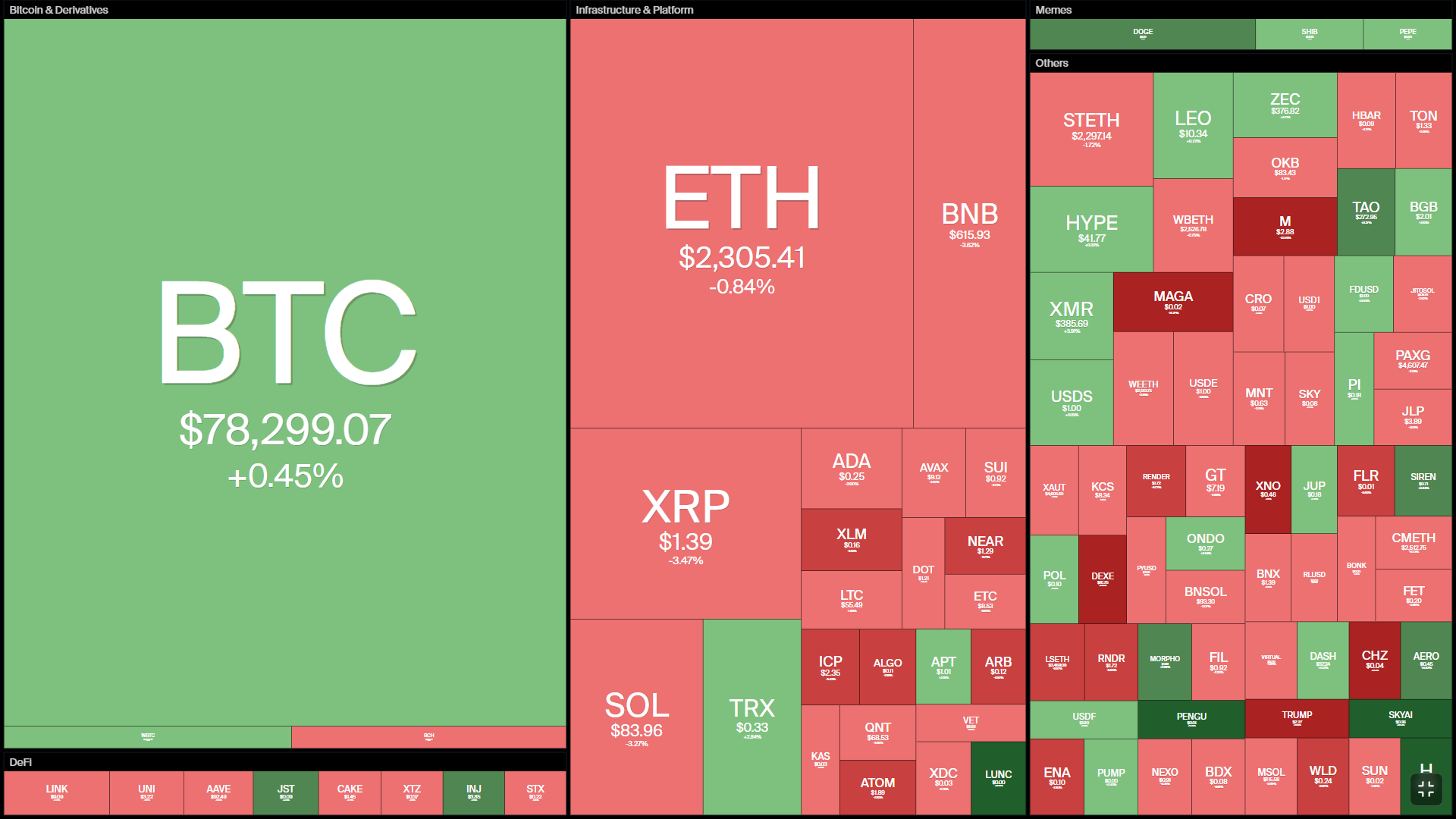
BTC finished the Apr. 26–May 2 week close to flat, increasing 0.45% to about $78,300, while ETH slipped 0.84% to about $2,305, leaving the market constructive but not broad-based. BTC traded roughly between $75,000 and $79,400, breaking above $79,300 midweek, touching its highest level in 11 weeks, before the FOMC event violently reversed momentum.
BTC ended April 2026 up 11.87%, its strongest monthly return in the past 12 months, while ETH gained 7.3%.
Market structure and crypto-native fundamentals
U.S. spot BTC ETFs added a net $162.8 million across Apr. 27–May 1, but that positive figure depended almost entirely on the $629.8 million May 1 inflow after three straight outflow days earlier in the week. ETH ETFs were weaker, with a net $82.5 million outflow over the same trading window despite a May 1 rebound.
The week's structure was defined by a pre-FOMC squeeze into weekly highs, followed by a sharp FOMC-triggered flush, and a partial recovery into the weekend — a textbook "buy the rumor, sell the news" playbook. BTC exchange net inflows hit 9,905 BTC on April 27 — the largest single-day net inflow in 30 days — while the Exchange Whale Ratio climbed to 0.707, its highest in over a week, signaling elevated selling pressure from large participants heading into the macro event.
Bitcoin 2026, held April 27–29 at The Venetian in Las Vegas, added an institutional layer to the week’s market structure. The conference did not create a clean price catalyst, but it reinforced the broader shift from passive BTC exposure toward operating-company models built around Bitcoin treasury, lending, payments, mining, and energy infrastructure.
Macro context and cross-asset comparison
Two macro events defined the week's narrative backdrop and interacted directly with crypto price action. First and most consequential: the Fed held rates at 3.75% on April 29, but the 8-4 dissent — the most divided FOMC since October 1992 — introduced significant policy uncertainty into markets. The statement reinforced a "higher-for-longer" stance, explicitly citing restrictive policy remaining until clearer inflation progress is achieved, triggering an immediate broad-based crypto sell-off. Adding a layer of transition risk: this was Powell's final press conference as Fed Chair before his May 15 exit, with Kevin Warsh expected to assume leadership from June and markets pricing a potentially more dovish pivot in H2 2026.
Second: the ongoing Strait of Hormuz disruption continued to act as a persistent macro headwind. Iranian forces declared the Strait closed since March 4, with Iranian forces attacking merchant vessels and the U.S. blockading Iranian ports since April 13, creating what Congress described as a "dual blockade." The FOMC statement itself explicitly cited "developments in the Middle East" as contributing to a high level of economic uncertainty — a direct acknowledgment that the Iran conflict is now embedded in the Fed's formal risk language. March CPI came in at 3.3% YoY with a 0.9% month-on-month jump — the largest single-month increase since 2022 — while Core PCE tracked at 3.45%, keeping the Fed's hands tied.
Oil prices, driven by Strait of Hormuz disruptions, rebounded to over $100/barrel, while the S&P 500 broke a new all-time high above 7,230, and the Nasdaq 100 ended the week at +2.32%. BTC’s mild weekly gain lagged that equity momentum, while gold was down 1.77% over the week, making crypto’s cross-asset signal inconclusive rather than cleanly defensive or cleanly risk-on.
DeFi Recovery and Protocol Security
Solana Foundation Deploys USDT to Support Aave After $292M Exploit
The Solana Foundation joined the recovery effort after an April 18 bridge exploit minted 116,500 unbacked rsETH worth about $292 million, creating liquidity stress across Aave markets. Solana Foundation President Lily Liu announced USDT lending into Aave, while AAVE was also listed natively on Solana through Sunrise DeFi.
The response included frozen attacker-linked ETH on Arbitrum, a DeFi United funding effort, and Aave Labs remediation planning. The incident was framed as a cross-chain infrastructure failure rather than a breach of Aave’s core smart contracts.
ZetaChain Exploit Hits Internal Team Wallets
ZetaChain contained a smart contract exploit on April 28 after a GatewayZEVM vulnerability allowed an attacker to drain internal team wallets. ZetaChain said user wallets were not affected, and cross-chain services were paused while the attack vector was blocked.
SlowMist identified the issue as missing access control and input validation in GatewayZEVM’s call function. ZetaChain later said the exploit stemmed from previously identified but unresolved issues, with total losses reported at about $334,000.
Wasabi Protocol Drained After Admin Key Compromise
Wasabi Protocol lost about $5 million after a compromised private key allowed an attacker to change admin rights and drain vaults across Ethereum, Base, Blast, and Berachain. Blockaid traced the root cause to wasabideployer.eth, the only address holding ADMIN_ROLE in Wasabi’s PerpManager AccessManager.
The attacker used the compromised admin path to upgrade perpetual vaults and LongPool to malicious implementations. Confirmed mechanics centered on compromised privileged access, while speculation about AI-assisted exploit discovery remained unverified.
Corporate Treasuries and Institutional Crypto Allocation
Corporate Bitcoin and Ether Treasuries Expand With New Large-Scale Purchases
Strategy, Strive Asset Management, and Bitmine Immersion Technologies disclosed new crypto purchases on April 27. Strategy bought 3,273 BTC for about $255 million, Strive acquired 789 BTC for $61.43 million, and Bitmine added 101,901 ETH during the prior week.
The purchases expanded Strategy’s holdings to 818,334 BTC, Strive’s holdings to 14,557 BTC, and Bitmine’s holdings to 5,078,386 ETH. Block separately disclosed 28,355 BTC in a first-quarter proof-of-reserves report.
White House Bitcoin Reserve Announcement Expected Within Weeks
The Trump administration expects to announce next steps for the U.S. Strategic Bitcoin Reserve within weeks. Patrick Witt said officials are working through the legal and operational framework for a reserve backed by government-held Bitcoin.
The reserve centers on Bitcoin already held by the government from criminal forfeitures and law enforcement seizures, not open-market purchases. Congressional codification could make the reserve permanent as lawmakers weigh legislation tied to broader reserve policy.
Stablecoin Rails, Payments and Tokenized Credit
Visa Expands Stablecoin Settlement Pilot to Nine Blockchains
Visa expanded its stablecoin settlement pilot on April 29 by adding Arc, Base, Canton, Polygon, and Tempo. The program now supports nine blockchains after beginning with Avalanche, Ethereum, Solana, and Stellar.
Visa said the pilot reached a $7 billion annualized settlement run rate, up 50% from the previous quarter. The expansion gives issuers and acquirers more blockchain options while Visa provides a common settlement layer across supported networks.
Meta Tests USDC Creator Payouts
Meta began testing USDC-based creator payouts on Solana and Polygon for selected creators in Colombia and the Philippines. Eligible users must connect a compatible external crypto wallet to receive USDC through Meta’s payout system.
The rollout uses existing infrastructure from Stripe, Circle, Solana, and Polygon instead of a Meta-issued currency. Wallet complexity, network selection, off-ramps, and private-key management remain adoption barriers for non-crypto users.
Coinbase Launches CUSHY Stablecoin Credit Strategy
Coinbase Asset Management launched Coinbase Stablecoin Credit Strategy, or CUSHY, on April 30 for qualified investors and institutions. The fund offers tokenized shares through Superstate and operates across Base, Solana, and Ethereum.
CUSHY is designed to generate yield from onchain lending and private credit. Coinbase Prime, Superstate, and Northern Trust support the institutional setup, with the strategy framed around public credit, private and asset-based lending, and tokenization-driven structural alpha.
Kbank Tests Ripple Remittance System in South Korea
Kbank partnered with Ripple to test blockchain-based overseas remittances, advancing to a stage where customer accounts and internal systems connect directly to onchain payment flows. The pilot includes transaction simulations and transfers to overseas markets including the United Arab Emirates and Thailand.
Kbank is using Ripple’s Palisade software solution. The pilot sits within South Korea’s pending stablecoin and digital asset rules, including draft legislation that would classify stablecoins as foreign exchange payment instruments.
Quantum Security and Cryptographic Risk
Solana Prepares Falcon Upgrade for Quantum Security
Solana outlined a post-quantum security path centered on Falcon, a lattice-based signature scheme selected after Anza and Jump Crypto’s Firedancer separately studied migration options. The Solana Foundation said no protocol change or user action is required today.
The roadmap targets long-term quantum-computing risk rather than an immediate Solana vulnerability. Falcon was chosen for compact signatures and post-quantum security, with staged wallet migration planned only if quantum threats become credible.
Quantum Key Break Triggers Bitcoin Security Debate
Project Eleven awarded Giancarlo Lelli its Q-Day Prize after he derived a private key from a 15-bit elliptic curve public key using cloud-accessible quantum hardware. The result did not break Bitcoin or compromise wallets.
The gap remains wide between a 15-bit demonstration and Bitcoin’s 256-bit elliptic curve security. Debate has shifted toward long-term risk for addresses with exposed public keys, while Bitcoin’s post-quantum migration strategy remains unresolved.
Tokenized Securities and Market Structure
Securitize, Computershare Plan Tokenized Shares for U.S. Issuers
Securitize and Computershare agreed to help U.S.-listed companies issue equity securities in tokenized form. The model centers on Issuer-Sponsored Tokens designed as direct equity ownership, not derivative-style tokens.
Computershare will act as transfer agent and process corporate actions for tokenized holdings alongside other directly registered shares. The structure is designed to let issuers retain control over capital structure, shareholder records, and investor communications.
U.S. Senate Bans Prediction Market Trading as Sector Expands
The U.S. Senate unanimously passed a rule on April 30 barring senators from trading on prediction markets, effective immediately. The move came amid concerns over insider trading, politically sensitive event contracts, and markets involving death or violence.
Prediction market ETFs were nearing potential launch, Gemini received CFTC approval for a derivatives clearing organization license, and Polymarket tapped Chainalysis to monitor trading activity and enforce market rules.
Regulation and Token Governance
Canada Proposes Crypto ATM Ban as Fraud Losses Surge
Canada proposed a nationwide crypto ATM ban after identifying the machines as a fraud and money-laundering risk. The proposal remains pending, with no confirmed start date, final penalties, operator obligations, or transition period.
Canadians reported more than $704 million in fraud losses in 2025, while losses since 2022 exceeded $2.4 billion. Separately, AIMCo disclosed a $219 million purchase of Strategy shares for Bitcoin-linked exposure.
Pump.fun Burns PUMP Tokens After Buyback Debate
Pump.fun burned all previously bought-back PUMP tokens on April 28, removing about 36% of circulating supply and introducing a one-year program directing 50% of future core product revenue to buybacks and permanent burns.
The burn destroyed tokens valued by Pump.fun at around $370 million. Backlash centered on traders who expected the accumulated buyback tokens could support future airdrops, community rewards, or ecosystem incentives.
Top Weekly Altcoin Gainers and Losers
Gainers:
Terra Classic LUNC (+46.08%)
Humanity Protocol H (+33.42%)
Pudgy Penguins PENGU (+15.61%)
Dogecoin DOGE (+9.48%)
Bittensor TAO (+8.60%)
Losers:
MemeCore M (-31.00%)
OFFICIAL TRUMP TRUMP (-23.14%)
DeXe DEXE (-21.16%)
Chiliz CHZ (-16.60%)
LayerZero ZRO (-12.38%)
This article has been refined and enhanced by ChatGPT.


